
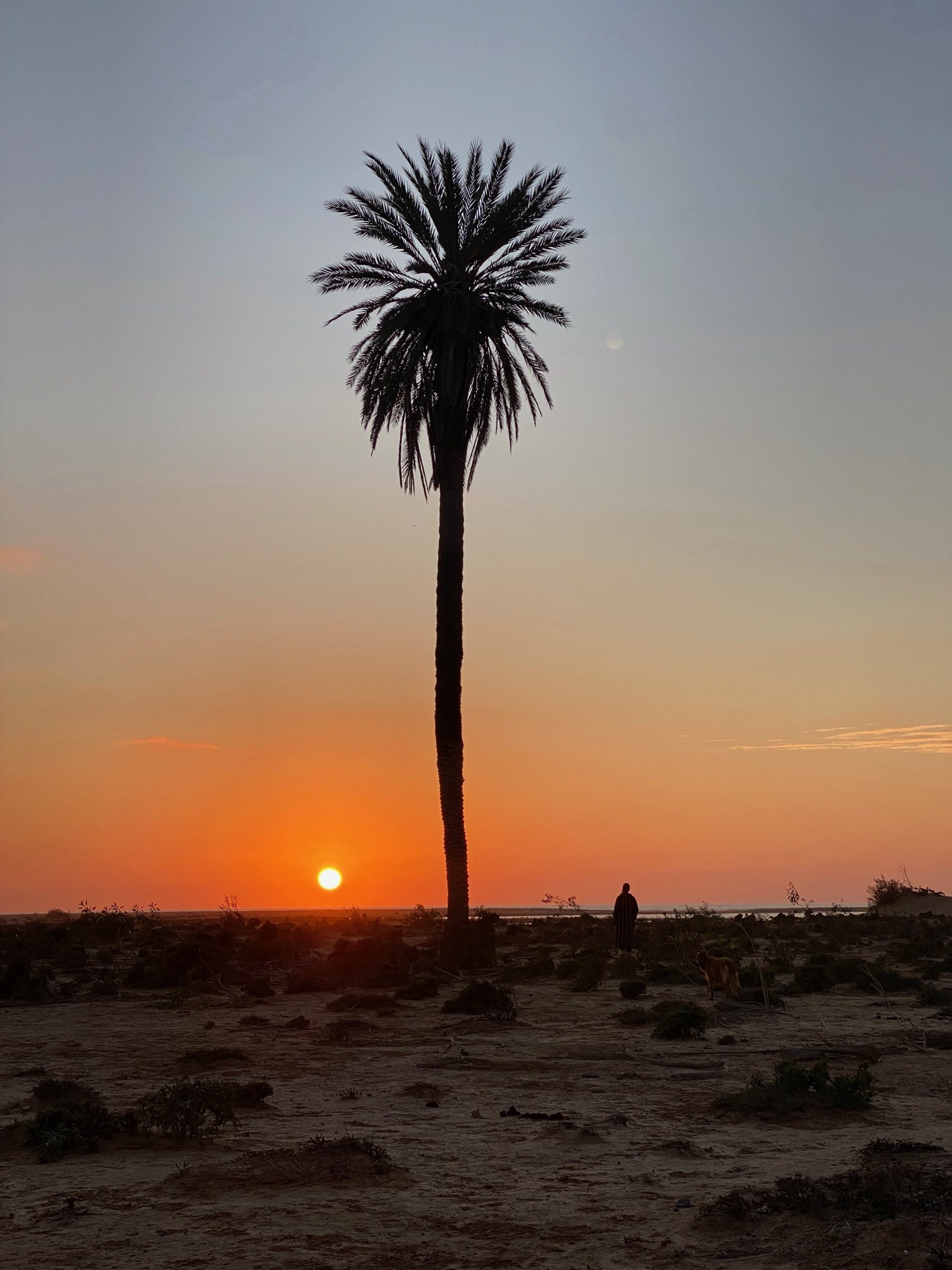
Dakhla happily surprised me. It's actually a proper city, which I didn't know. After all that empty road you're suddenly in a city of around 100,000 people. It's not a particularly pretty city but it's definitely vibrant and interesting. There's a really nice mix of people. It's a little bit rough on its edges and there's good cafes everywhere. There's people from all walks of life who come there to travel, to surf, to guide, to work. It's a really nice mishmash.
It's a great winter escape. Most people fly in for a week of kiting and you're on the lagoon the same afternoon. We drove down with the van and stayed five months in the south over two winters, so this is the long version. Where to stay depends a little bit on your goals, and that's what this post is for.
Why go kitesurfing in Dakhla
Wind is pretty much guaranteed. So if you love kitesurfing this is a really good place to be in winter. There's direct flights from Europe. And there's lots of adventurers who make the long drive down from the north, like we did. The Dakhla lagoon has flat water and there's plenty of room, with space enough for everybody even in the windiest months. We packed kites of 8, 10 and 12 metres and used all of them. In December and January you'll mostly be on the 12. And there's also some really nice surf breaks, which I don't all want to share. I really enjoyed surfing at West End when the wind dropped.
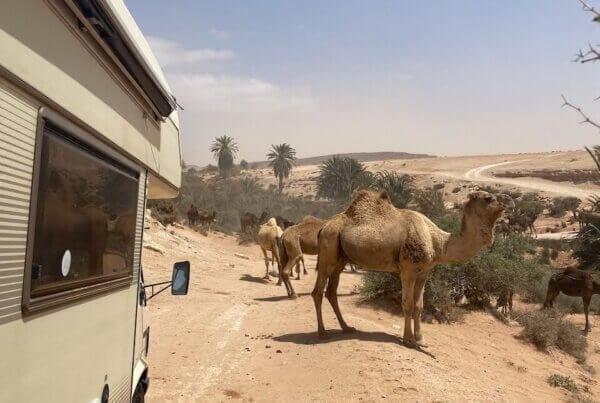
Then there's the desert around it. I've never seen so many camels. I've never seen so many stars. On a new moon, parked somewhere out there with dinner on the fire, you get the clearest night sky you'll ever lie under.
When is the kitesurfing season in Dakhla
The wind blows around 340 days a year. It comes from the north-east and gets squeezed between the dunes and the lagoon, so it's usually lighter in the morning and picks up around 2 pm. From my own winters there: surf is best October to January, with calmer wind and cleaner waves. From February the wind gets in and that's when the kiters are happy. The numbers below are what the schools and wind stations report, so you can match the wind conditions to your level. If you want to learn to kitesurf, the quieter months are easier on a beginner.
| Months | Wind | Water | What it's good for |
|---|---|---|---|
| February to March | Wind comes back, 14 to 22 knots | 17 to 19°C, 3/2 wetsuit | Quieter lagoon, good for learning, still some waves |
| April to August | 20 to 30 knots most days, up to 35 in July and August | 20 to 25°C | The strongest wind and the busiest camps |
| September to October | Still strong, waves starting on the ocean side | Warm | Kite and surf in the same trip, October is the sweet spot |
| November to January | Lightest, 10 to 20 knots, roughly 6 in 10 days kiteable | 17 to 19°C, 3/2 wetsuit | Bring the big kite, best waves, winter sun |
The best kitesurfing spots in Dakhla
The Speed Spot is probably the best flat water kitesurfing there is. With the van you can park next to the abandoned hotel to be out of the wind. Be careful with the sand, you won't be the first to get stuck there. The main lagoon in front of the kite camps is where the kite schools teach and where the kitesurfers do their downwinders to the White Dune, with a boat behind them and a 4×4 to bring them back.
West End is a funky park and surf spot on the ocean side. The wave is really nice and on windy days you can kite there too. There's a botanical garden in the backyard, which is even funkier. Pointe de l'Or is the other wave spot on the Atlantic Ocean side, with soft sand where a 4×4 helps, and Ponta Negra is nearby.
One thing to know about the lagoon is the tide. At low tide the sandbanks come up and you can kite from pool to pool across to the dune. At high tide around new moon the water comes a long way up the beach. We could only park on the lagoon until just before new moon, otherwise the van becomes a vessel.
Where to stay in Dakhla for kitesurfing
Accommodation in Dakhla comes in three kinds, so the first thing to decide is where you base yourself. The kiting is on the flat water lagoon, about half an hour's drive north of Dakhla town. The waves are on the Atlantic Ocean side of the Dakhla peninsula. The town is where the life is, with the cafes, the markets, the hammam and that mix of people. You can't walk between the three, so it depends a little bit on your goals.
Kite camps on the lagoon
If you come for kiting you want to be right on the beach, so you can wake up, look at the water and go. That's what the kite camps along the lagoon give you. Most of them do half or full board, have a kite school on the beach and rent all the kitesurfing equipment. I travel differently. But if you have one week and the wind is the reason, it works.
PK25 is quite a nice spot. It has a good location, not crazy far from town, and you're right on the lagoon. It might be a little bit busier. I really enjoyed working from the restaurant a few times. People are sweet and kind and you can rent all the gear there.
White Dune Canyon is very special. It sits further down the lagoon, opposite the White Dune, with the ION Club school in front of it. It's built from natural materials and runs on solar. At low tide you can kite from the camp across the sandbanks to the dune itself.
Secret Spot could also be a very nice choice. It's a small camp of around ten Saharoui tents, 5 minutes from the White Dune and 15 from the Speed Spot, so you're away from the teaching crowds. The tents are simple and it books direct, by email or phone, not through the booking sites.
Then there's the big names I haven't slept at, so I can only tell you what they are. Dakhla Attitude was the first camp on the lagoon and is the biggest and most social one, next to the Speed Spot. Dakhla Club is more of a hotel, with a pool and a spa. Dakhla Spirit is the smaller eco camp on the same stretch. Dakhla Kitesurf World at PK27 is the simpler and cheaper beach camp.
The ocean side for waves
If you'd rather surf than kite, or you want both, look at the Atlantic side of the peninsula around Oum Labouir. This is where I'd send a friend.
La Merveille guesthouse is where I actually slept. Super lovely people. Wingo was allowed too and we could even park the camper inside, which was great. Breakfast is included and it's good. It sits right by the beach at Oum Labouir, on the ocean side, about 20 minutes from town.
Westpoint Dakhla is the surf hotel, with wooden cottages right on the wave at Oum Labouir and a kite and surf school. I haven't stayed there but it's where the surfers go.
Ocean Vagabond Lassarga is the camp at the tip of the peninsula, where the lagoon meets the ocean. Booking.com rates it the top hotel in Dakhla and I had some really nice surf there. I still found it a tough one. It's built right next to a fishing village, with burned-out boats on the beach, and I never had so many flies in my van as there. A few times the water was very dirty. It definitely has its pretty bits but the contrast is too big for me, between sitting in your little house and the whole mishmash next door. If the wave is what you're after you might not mind.
An apartment in town and a car
I don't see it as a bad option at all to rent an affordable apartment in the city. If you'd rather have Dakhla itself around you, stay in town and rent a car. It's really nice to have a car there. Then you can kite the lagoon in the morning, surf at West End in the afternoon and still make it to the night market. Just realise it's a half hour drive each way to the kite spots. When I was there I was also looking for places to stay for friends and I found a few nice ones. Hostels start around 27 euro a night and apartments run 50 to 80. They're all on the map below.
How to get to Dakhla from Europe
You can fly straight into Dakhla airport. Ryanair flies from Madrid year round and from Lanzarote in season. There's direct flights from Paris Orly and Marseille with Transavia. Binter connects Gran Canaria, and Royal Air Maroc goes via Casablanca. There's no direct flight from the UK yet. The airport is a few kilometres from Dakhla town and the kite camps usually include the airport transfer. Check the exact days before you book, because the Lanzarote and Marseille routes change by season.
Or you drive down from Agadir, like we did. It's a long way but the road is very, very good. It's around 1,150 km on the N1 along the coast, which is 13 to 15 hours of driving. People sleep on the way in Boujdour. The campsite there (Camping Sahara Line on the corniche, around 70 dirham with hot showers) is really nice, and there's cheap hotels along the main road if you're not in a van. The last 370 km from Boujdour to Dakhla has the worst potholes of the whole trip, so don't drive that part at night.
A few things I learned down there. Park4night's satellite view works better than Google Maps, which is often wiped. ATMs often don't work, but the Al Barid bank did, so carry cash. Fuel is cheaper the further south you go. Road exits are marked with tyres and poles of rock, not signs. And every so often you pass something that makes no sense and total sense at once, like an ice cream van in the middle of nowhere.
Is Dakhla safe
We travelled this stretch for months without a serious incident, and I felt safer leaving the van there than in many places in Europe. There are guard posts every kilometre or two along the coast. Don't let the guys with the big guns intimidate you, they're almost always friendly. Keep your fiches ready (a printed sheet with your passport and vehicle details, in French), say hello, and roll on. Don't photograph anything military.
The part to take seriously is the Berm, the militarised sand wall that runs inland the length of the territory. The UK government advises against all travel near it and to everything south and east of it, because of landmines. The normal route is the coastal road. Stay on it and you won't get anywhere near it.
Western Sahara is a disputed territory and the UN still lists it as non-self-governing. Morocco administers the whole coastal strip you'll travel, including Dakhla. It's a sensitive subject for the people who live there, so follow local instructions, tread lightly and listen more than you opine. Locally it's called the Moroccan Sahara and that's the sensible term to use with officials. Daily life on the coast feels like any medium-sized Moroccan city, with the wind more of a daily companion than anything else. For a feel of the place, watch Jonatan's film on our eight months in Morocco and Western Sahara.
What to do in Dakhla when the wind drops
If there's no wind the surf at West End is quite amazing. Further south there's nice waves too, and a few spots I'm keeping off the map. The rest of the time it's a lot of marveling, observing and eating.
Go to the Thursday night market. I love to go for the harira soup and the msemen, and the bottles of yoghurt are a pretty good deal too. The daily market in town is a good spot to stock up on fresh local produce. Eat in the local places: a Berber omelette, a bowl of bissara for breakfast, mint tea all day. And definitely go to the hammam. The neighbourhood ones, not the tourist ones, around 15 dirham, full of grandmothers and dads with their sons. Bring a scrub glove and black soap, and for 50 dirham more a local lady scrubs you. You come out new.
There's an oyster farm on the lagoon where you can eat them fresh on the spot. Climb the hill behind it for the view. The White Dune and Dragon Island are the two trips every camp sells, and both are worth it. Check the tide, because the crossing floods when the water comes back. The fishermen who go out on tubes were very special to watch. And if you have a car, drive south. It gets wilder the further you go, with a lot of beauty in the desert. There's also a secret hot spring out there. I've pinned it in my Morocco guide and on the Ocean Nomads map, but I'm not putting it out in the open.
Working from Dakhla
Dakhla is a good winter base if you work remotely. Morocco runs on UTC+1 all year, so in winter you're on the same clock as most of Europe and your calls stay at normal hours. The internet situation is fine. I mostly worked from 3G there. There's some bars here and there you can work from, and the restaurant at PK25 was a good one for me. For a long stay off-grid, Starlink Roam is the option.
Dakhla with a dog
Wingo loved it. Dogs are allowed pretty much everywhere down there, there's beaches to run and he even got on with the dromedaries. The stray dogs are super sweet and not to worry about. I wish I could take them all, and that's the sad side of being there with a dog you love. What actually helps them is the slow work of the local associations, so if you want to give something back, start with the ones in my Morocco guide. The paperwork to bring your own dog into Morocco is in there too.
Dakhla by van
If you kite, Dakhla is the reason to point the van south. You can park right at the spots, there's lots of space and it hardly gets busy. Two tips from experience: be very careful with the soft sand, you won't be the first to dig a van out, and park where you're sheltered from the wind for the night, because it can blow hard. Water is the one real constant to manage, so carry plenty and fill whenever you pass a point. And when the old van needs a hand, there's a mechanic in the south I'd go back to, Salam Mechanical Store. Morocco is hard on tyres and old cars. Everything else about the van down there, from the ferry and the fiches to where we slept and surfed, is in my Morocco by van tips and in the map guide with all our spots.
Questions people ask about Dakhla
Is Dakhla worth visiting if you don't kitesurf?
Yes. There's a hundred thousand people living there, so there's a lot going on and a lot to explore. You can definitely have a special, memorable time without a kite. Come for the surf, the desert, the markets, the hammam, the oysters and the drive south. It's not a place for sights or nightlife. Give it time and it's richer than it first looks.
Is Dakhla in Morocco or Western Sahara?
It's both, depending on who you ask. Dakhla is in Western Sahara, a disputed territory that Morocco administers. You enter it on a Moroccan visa, pay in dirham and you can't really tell when you cross from Morocco into Western Sahara on the coast road. More on this under is Dakhla safe.
Do you need a car in Dakhla?
If you stay at a lagoon camp and only kite, no. The camps pick you up at the airport and the spot is in front of your room. If you stay in town or want to see the ocean side and the desert, yes. It's really nice to have a car there.
Is Dakhla expensive?
Town is cheap. Hostels from around 27 euro, apartments 50 to 80, a home-cooked meal for a few euro, the hammam for 15 dirham. The kite camps and resorts in Dakhla are the expensive part, mostly full board packages. Money goes a long way here, and cash runs the place, so draw a good chunk at once when you find an ATM that works.
Explore more
Read next
 Tarifa to Chefchaouen: weekend trip from Spain to Morocco
 Vanlife Morocco Guide 2026: Campervan, Dog & Costs
 Tarifa travel guide: kitesurf, adventure and where to stay (2026)All my Morocco posts
Watch on YouTube


Wild at heart? Let's be friends.
Join me on YouTube for slow travel adventures by van, sail and on foot.
Or get my new stories by email, every couple of weeks.
Ocean Nomads is the community I founded, for people who want to live a little wilder, explore a little further, and do it with good people.
For deeper trail stories and the behind-the-scenes, I write on Patreon.
Stay wild.
With love, Suzanne
About Suzanne
Six years living in a van, nine months of it in Morocco and Western Sahara with my dog Wingo. Five Atlantic crossings and 50,000+ nautical miles at sea. 2,500+ km of thru-hiking. Founder of Ocean Nomads. I travel by sail, van and on foot. Full bio: about me. Say hi on Instagram or YouTube.
Disclaimer: As always, opinions are my own. What drives me is care for nature, getting you into nature, and encouragement for natural living. If you're looking to book a place to stay or a gear item, huge thanks if you purchase it via this website. At no extra cost to you, orders and bookings through this website give me a tiny piece of the pie that helps me keep investigating, exploring, and creating content about living with and for nature.
Related Posts
None found