
Last updated: September 2026. Garmin launched the Mini 3 and Mini 3 Plus this year. The full comparison is further down.
Short answer, now that the Mini 3 is out: I've had a Mini for many years and it works fine. The most important thing is that you can be found if it's ever needed, and that you can check the weather with it. That's what this one does. Less is more.
I'm on my fourth Atlantic crossing. Middle of the night. Everyone else is sleeping. I'm alone on deck watching the waves come in long and dark, and I realise: if one of these takes me over the side, I'm gone.
The small thing in my pocket is the reason mum can sleep too.
It's the Garmin inReach Mini 2. Same device in my lifejacket on offshore deliveries since. Same device clipped to my pack on the GR11 across the Pyrenees with my dog Wingo, and through the Waitukubuli National Trail in the Caribbean jungle. Same device in the glove box of the van in Morocco, where Starlink isn't licensed and you can go days without signal.
Most reviews of this thing are written by hikers, or by sailors. Not both. I've carried an inReach for eight years now, the original Mini first, this Mini 2 since. This one is what those years across all three lives have taught me.

Planning your first multi-day hike? I'm finishing a field guide for exactly that, Your First Hike, out this autumn. Join the waitlist and you'll get it first, at a launch price.
One email when it is ready, with the launch price. You can unsubscribe at any time.
What the Garmin inReach Mini 2 actually is (and who it's for)
100 grams. Fits in a jacket pocket. Monochrome screen, four physical buttons, USB-C, battery that lasts days. That's the whole pitch.
What it does, in plain words. It sends and receives short text messages from anywhere on Earth, even mid-ocean, through the Iridium satellite network (66 satellites, true global coverage, including Antarctica). It shares your live location on a MapShare page anyone you've invited can watch. It pulls weather forecasts (basic, premium and marine premium since the 2024 firmware update, which now comes automatic on every Mini 2). It has an SOS button that connects 24/7 to Garmin Response in Texas, who have handled over 150,000 alerts in 200-plus countries. It pairs with the Garmin Messenger app on your phone for faster typing, or with a Garmin watch for wrist control. It works standalone if you've got no phone signal.
What it isn't. A chartplotter. An EPIRB. A registered distress beacon. A GPS with maps on it. A phone replacement. It does one job. Keep you in touch with the world when nothing else can.
Best for solo travellers, crew on boats without satellite gear, thru-hikers going into spotty terrain, vanlifers crossing places where cell coverage drops out for days, and anyone whose mum worries when they go quiet. Skip it if you stay on cell service.
Find the Garmin inReach Mini 2 near you
On a sailboat as crew: the pocket lifeline offshore

Most offshore boats have an EPIRB bolted somewhere and an Iridium Go or a satellite phone at the chart table. That's the boat's safety net. It is not yours.
If you're alone on deck at three in the morning and a wave takes you over, the boat's gear can't help you. The thing in your pocket can. That's the whole reason I started carrying the Mini 2 on my fourth crossing, and why it's been in my lifejacket on every offshore mile since.
Two situations come up. First, the boat already has satellite comms. The Mini 2 is your personal redundancy. Clip it to your lifejacket harness with a lanyard, not loose in a pocket where it can fall out. If you go over, you can press SOS yourself. A completely different conversation with the rescue services than waiting for someone on the boat to notice.
Second, the boat doesn't have its own satellite gear. Delivery skippering, friend's catamaran, charter boats, smaller cruising boats. The Mini 2 becomes the boat's link to weather and to shore. It pulls a marine forecast for one dollar per request, for a single latitude and longitude. Not a wide-area picture you'd route a passage off, but enough to know what's coming at you over the next 24 hours.
One real limit. The Mini 2 is IPX7, not IP67. It survives splashes and 30 minutes of accidental submersion to one metre, but it isn't dust-and-water-tight the way the newer Mini 3 Plus is. After weeks of salt spray on deck, keep it in a small dry pouch when it's not in active use. Rinse it in fresh water after a passage.
And it isn't a substitute for a registered distress beacon. EPIRBs and PLBs transmit on government Cospas-Sarsat satellites and exist purely to bring rescue. The inReach is a personal communicator that can also send SOS. Different tools, different jobs. For serious offshore, a personal AIS Man Overboard beacon goes in your lifejacket alongside the inReach. Belt and braces.
Explore the best deal on the Mini 2
If you're crewing an Atlantic crossing this winter and the boat doesn't have its own satellite kit, this is the one piece of personal gear I'd argue for. We use them on our Ocean Nomads crossings and sailing trips, and I cover full offshore crew safety gear in a separate post.
Thru-hiking and remote trails: weather, tracking and the GR11 test

I carried the Mini 2 across 850 km of the GR11 through the Pyrenees with Wingo, and earlier through the Waitukubuli National Trail across Dominica's rainforest. Two very different terrains. The same two features mattered most.
Weather, where there is no signal. Somewhere on the GR11, the nearest town two days' walk away, no phone signal in any direction. The only way to check the weather was the satellite in my pocket, and I was glad I had it. The forecast showed rain and thunder moving in early the next morning. So I pushed on, made as much ground as I could before dark, and got the tent up while it was still dry. Another day on the same trail, looking at a 2,800-metre pass with the sky doing something I didn't like, the forecast told me the opposite: camp low, start at dawn, let the storm blow through. On the standard plan a weather pull counts as one of your monthly messages. On the GTC plans in the UK it's about 50p. Cheap, for the difference between a good call and a bad one at altitude.
MapShare for the people on the other end. Mum watches the breadcrumb trail. Partner watches it. Anyone you've shared the link with can see your last position, how long ago it updated, and whether you're still moving. They don't need an app. They get a web page. The “she's still moving” signal means more than a text, especially on the days you forget to send one.
Weight is real-world insignificant. 100 grams. On a 7 kg setup it doesn't tip anything. My full thru-hiking gear list with Wingo is in a separate post if you want to see how it fits.
Tree canopy is where the Mini 2 struggles. The antenna is 1.51 watts (the Mini 3 Plus is 4.68 watts). In dense forest the radio keeps hunting for satellites, messages take longer than the usual 1 to 3 minutes, and battery drops fast. In Waitukubuli's jungle I'd get delays of 10 to 20 minutes and occasional drops. In open Pyrenees alpine, near instant.
Keep the device on all the time on trail. It passively checks for messages every hour even when you're not using it, and Garmin can return a last-known position to authorities if you're missing. Battery still lasts days.
A handheld GPS with maps is a different tool. So is iPhone satellite SOS, which makes you hold perfectly still while it connects and dies in hours. The Mini 2 covers what neither does well.
Check the current price of the Mini 2 · Dutch readers here
Vanlife and overland: where Starlink still doesn't reach
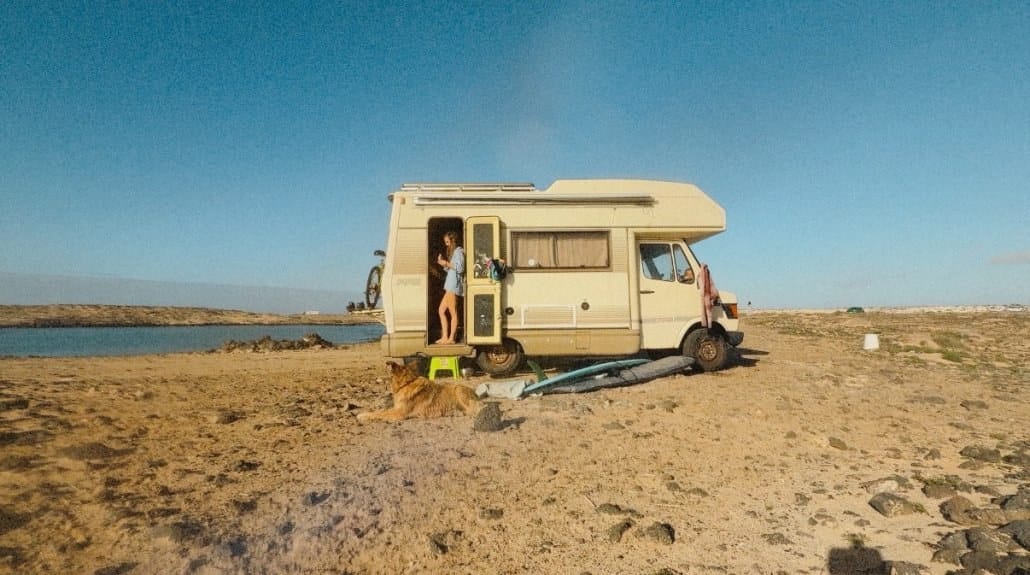
Loads of vanlifers assume Starlink solves the off-grid problem. It does, where it's licensed (get 1 month Starlink for free). It isn't licensed everywhere.
Morocco is the example I know best. Starlink is still not licensed by ANRT, the Moroccan telecom regulator, as of May 2026. Overlanders coming down through the High Atlas, through the Anti-Atlas, or along the Atlantic coast end up with two or three day stretches of no signal at all. The Mini 2 worked for me every time. Daily check-in to family. Weather pull before going into a remote stretch. The SOS button as the backup nobody hopes to need.
Other places where this matters: parts of Central America, much of the Sahel, and a handful of countries where the device itself is restricted by law. India bans satellite communicators under a leftover British colonial-era law. Travellers have actually been detained. China, Russia, Cuba, Burma and North Korea also restrict them. Check Garmin's country restriction page before you cross a border with one.
When you can skip it: tarmac-only Europe trips with full cell signal everywhere. Probably overkill. The moment you go off the pavement or out of EU coverage, this device earns its keep. I had it on the dash for our Morocco vanlife trip and used it the way I'd want anyone solo and remote to use it. As the quiet thing in the background that means someone always knows where you are.
Find the Garmin inReach Mini 2 near you
Battery life, charging and the everyday features
The stuff you actually use between emergencies. Battery first, because it's the question I get most. On the default 10-minute tracking the Mini 2 lasts me around two weeks. Ping it less often, say every four hours, and it stretches well past that. It charges over USB-C, the same cable as everything else in the van, so there's no special dock to lose. On long trips I top it up from a small power bank and stop thinking about it.
Messaging, in practice. You can fire off a preset message (“all good”, “making camp”) for free on most plans, type a custom text on the four buttons, or pair the device over Bluetooth with the Garmin Messenger app on your smartphone and type properly. A daily check-in costs almost nothing and buys a lot of peace of mind for the people at home. Messages send and arrive over the Iridium satellite network, usually in one to three minutes in open sky.
Navigation is basic, and that's worth being straight about. The Mini 2 will drop waypoints, walk you back along your track with TracBack, and give you a bearing on its little screen. It is not a mapping GPS. For actual maps, routes and trip planning you use the free Garmin Explore app on your phone and sync to the device. If you want maps on a screen in your hand in the backcountry, that's a GPSMAP or your phone, not this.
The SOS button: what actually happens when you press it
Almost everyone who buys this device hopes they never use the button. The people who have pressed it for real give the most useful information.
How it works. Lift the protective cap. Hold the button down. A loud 20-second countdown plays before the signal goes out. You can cancel during the countdown. Once it fires, GPS coordinates and a default message go to the Garmin Response team, who operate 24/7.
Three stories show what happens next.
One of our Ocean Nomads pressed his Mini's SOS in a real emergency at sea. The button is the reason he's still here to tell it. He's written the whole story inside the Ocean Nomads community, where it lives as a member post. People keep telling him it deserves to be a book. He doesn't seem to be in a rush.
Martin was hiking the Cape Wrath Trail in Scotland when he dislocated his hip at 09:10. He pressed SOS. Garmin Response coordinated with Inverness Coastguard. A helicopter arrived by midday. Three hours, SOS to hospital. Garmin kept his wife briefed throughout because she was on his emergency contacts list.
Meg was in the Wind River Range when her friend broke his leg. The weather grounded the helicopter overnight. Her rescue took 20 hours. Garmin checked in every hour through the night, even when local dispatch had gone to bed. Two practical lessons from her story: tracking in SOS mode cannot be turned off, and it drains battery fast. She went through two full charges of her Mini 2 in 20 hours. Carry a battery pack on any trip where you might press the button.

A few things worth knowing before you go.
Your emergency contacts must be current before every trip. Garmin will not share rescue information with anyone not on the list. Meg's spouse couldn't get updates because he wasn't on hers.
The stock carabiner the Mini 2 comes with is not great. There's a documented case of a hiker's device detaching during a fall. Replace it.
Garmin sells SAR insurance (Standard, High-Risk, High-Altitude) for US and Canada users, up to $100,000 per claim per year. European users aren't covered by Garmin's own scheme. Look at private SAR cover or trip insurance with proper rescue coverage instead.
The system works. The button works. Make sure your contacts are current, carry a battery pack, and replace the carabiner.
Explore the best deal on the Mini 2
Subscription plans, the rescue add-on, and what it really costs
A subscription is real. You can't escape it. But you don't have to pay every month.
Garmin has four tiers, plus a UK reseller (GTC) that's often better for European customers. In rough numbers: Enabled is the cheapest, about $7.99 or €9.99 per month, giving you SOS access and pay-per-use for messages, tracking and weather. Essential adds 50 messages a month and basic tracking. Standard gives you 150 messages and unlimited 10-minute tracking, which is the sweet spot for a thru-hike or an Atlantic crossing. Premium is unlimited everything for continuous expedition use. GTC's Pro Enabled runs about £12.99 a month inc VAT and works well if you're buying through a European reseller. The Yachting World team used GTC's £45 monthly plan for their Atlantic test (60 texts, 600 tracking points). That was enough for hourly position updates across an entire ocean.
Activation fee is roughly £39.99 / €39.99 / $39.99, paid once. You need Wi-Fi or cellular to activate. You can't activate the device in the field after you've already started a trip. Set it up at home in the days before you leave.
The feature that makes a Mini 2 financially sane for someone who does one big trip a year is the suspend option. Garmin's annual plans let you pause for up to 12 months at a time, no reactivation fee. Suspend in winter if you only sail in summer. Suspend in summer if you only hike in winter.
You can pick up the Mini 2 itself through my partner link (Dutch readers here) if it's useful. Costs you nothing extra.
Quick rule of thumb. Sail once a year? Run Enabled and suspend between trips. Thru-hike for months? Standard is sized for you. Remote continuously? Pay for Premium. Match the plan to the trip pattern, not to the salesperson.
What it doesn't do well (and the 2026 alternatives)
One thing worth being straight about before the comparison. I've carried inReach devices for eight years, the Mini 2 for the last few, across all three lives. I haven't tested the Mini 3 or Mini 3 Plus myself, so what you read about those here is from the specs and from reviewers I trust, not my own hands. The Mini 2 is the one I can actually vouch for.
| Mini 2 | Mini 3 | Mini 3 Plus | |
|---|---|---|---|
| Price | ~$250 | ~$449 | ~$499 |
| Weight | 100 g | 122 g | 139 g |
| Screen | Monochrome, four buttons | Colour touchscreen | Colour touchscreen |
| Messaging | Text | Text only | Text, voice notes, photos |
| Water rating | IPX7 (splashproof) | IP67 | IP67 (better with salt) |
| Antenna | 1.51 W (weakest) | Same as Mini 2 | Stronger, higher bandwidth |
| Best for | Light, simple, cheap | Skip it | Every feature, phone-free use |
The Garmin inReach Mini line-up in 2026. Specs from the Mini 3 launch.
Three things the Mini 2 doesn't do well.
Tree canopy. The 1.51-watt antenna is the weakest in Garmin's current Mini line-up. Messages take longer and battery drains faster under heavy cover.
Typing on the device. Four physical buttons and a tiny monochrome screen are fine for “all good” and “on my way.” Anything longer and you'll want to pair with the Garmin Messenger app on your phone. The Mini 3 Plus added a touchscreen and a small QWERTY. The Mini 2 didn't.
Salt spray over weeks at sea. IPX7 is splash-rated, not IP67 dust-and-submersion-rated. Keep the Mini 2 in a small dry pouch when it's not in active use, and rinse it in fresh water after a passage.
A few alternatives worth knowing in 2026. The Garmin inReach Mini 3 Plus is the current top-of-line Mini: touchscreen, voice and photo messaging, IP67, better antenna, $499, 25% heavier. Worth it if you want standalone use without a phone or you're going offshore for months. There's also a base Mini 3 at $449, but it's text-only like the Mini 2 with a colour touchscreen bolted on. For $50 more the Plus makes far more sense, so I'd skip the middle one. The Garmin Messenger Plus is what Backpacker Magazine ranked best overall in 2026 (phone-dependent, 600-hour battery), the right pick if you always carry a phone anyway. Zoleo is the budget option at $149 with $20/month plans. I haven't carried one, so I won't pretend to review it, but the reported issues put me off: check-in messages that send without GPS coordinates (you tell family you're safe, they have no idea where you are), mid-emergency communication failures, plus 3-month commitments, cancellation penalties, and charges after device return. I'd put the money toward one of the Garmins instead.
For a registered distress beacon offshore, an EPIRB or a personal PLB is a separate tool. The Mini 2 is not a substitute.
If you want the lightest, simplest, in-pocket-or-in-lifejacket option that has worked everywhere I've actually taken it, the Mini 2 is the one I recommend, and the one I keep coming back to. If you specifically want voice notes, photos and a touchscreen, that's the newer Mini 3 Plus, though I haven't tested it myself. And if you always travel with a phone anyway, the Messenger Plus is worth a look. For most people, most of the time, the Mini 2 is plenty.
The bottom line
It's the smallest, simplest piece of safety kit I own. And the one I'd unpack last.
Sixth Atlantic crossing? Yes. In my lifejacket pocket.
Next long thru-hike? Yes. Clipped to my pack strap.
Back to remote Morocco in the van? Yes. On the dash.
What I'd say to anyone debating it. The Mini 2 doesn't replace good seamanship or trail sense. It isn't a registered distress beacon. It's the in-between layer. The thing that lets you ask a question, share a position, or call for help when nothing else can reach you. Once you've travelled with one for a while, you stop noticing it's there. That's exactly what you want from safety kit.
Find the Garmin inReach Mini 2 near you
You can pick one up through my partner link if it's useful. Costs you nothing extra.
FAQ
My phone has satellite SOS now. Do I still need a Garmin inReach Mini 2?
For most remote travel, yes. Phone satellite (iPhone Emergency SOS, the newer Pixels) is built for one thing: firing off a distress call when you have no signal. It's emergency-only, often makes you hold still and aim at clear sky, and it isn't a conversation. The Mini 2 does the everyday job around the emergency. Two-way messaging with anyone, hourly tracking your family can watch on a web page, satellite weather before a pass or a passage, and a battery that lasts days instead of the hours your phone gives you. If you break down a mile from a road, your phone might be enough. For multi-day stretches offshore, on trail, or off-grid in the van, the inReach still does things the phone can't, and it does them without draining the one device you also need for everything else.
Is the Garmin inReach Mini 2 still worth it in 2026?
Yes, if you don't need photos, voice messaging or a touchscreen. The Mini 2 is now the budget option in Garmin's lineup at around $250, and it does the core jobs (SOS, two-way messaging, tracking and satellite weather) as well as it did when it launched. If you can stretch to the Mini 3 Plus or want the best-overall battery on the Messenger Plus, those are the newer picks. For most people heading offshore or onto trail, the Mini 2 is still the right balance of size, price and reliability.
Garmin inReach Mini 2 vs Mini 3 vs Mini 3 Plus: which should you buy?
Three models now, and the choice is simpler than the line-up makes it look. The Mini 2 (around $250) is the lightest and simplest: text messaging, SOS, tracking and satellite weather, four buttons, nothing to fuss with. It's what I carry. The Mini 3 Plus (around $499) is the upgrade worth paying for if you want it: colour touchscreen, voice notes, photo sharing, a stronger antenna, and an IP67 rating that handles salt spray better offshore. The base Mini 3 (around $449) sits awkwardly in between, colour touchscreen but still text-only, and for $50 more you may as well get the Plus. So: Mini 2 if you want light, simple and cheap. Mini 3 Plus if you want every feature and standalone use without your phone. Skip the middle one.
Do I need an EPIRB and a Garmin inReach Mini 2 for offshore sailing?
For serious offshore, yes. An EPIRB is a registered distress beacon that transmits on government Cospas-Sarsat satellites and exists purely to bring rescue. It doesn't message. The Mini 2 is a personal communicator that can also send SOS, but it isn't a registered distress beacon. They cover different scenarios. Practical setup: boat carries an EPIRB, you carry the Mini 2 in your lifejacket pocket. Add a personal AIS Man Overboard beacon if you'll be alone on deck at night.
How does Garmin Response actually work when I press SOS?
The button triggers a 20-second countdown that you can cancel. Then your GPS coordinates and a default message are sent to Garmin Response in Montgomery, Texas, who operate 24/7. They message you back within seconds asking the nature of the emergency. You can reply with automated answers if you can't type, then with more detail when you can. They coordinate with local search and rescue or the Coast Guard, and they keep your listed emergency contacts updated throughout. Make sure your emergency contacts are current before every trip.
Can I pause the Garmin inReach subscription between trips?
Yes. Garmin's annual plans allow up to 12 months of suspended time per year with no reactivation fee. This is the feature that makes the Mini 2 financially sane for people who do one big trip a year and put the device in a drawer the rest of the time. Activate before your trip (it needs Wi-Fi or cellular at home), use the plan during, suspend afterwards. The device cannot be activated in the field after a trip has started.
Does the Garmin inReach Mini 2 work in heavy tree cover?
Mostly, but slower. The Mini 2's 1.51-watt antenna is the weakest in Garmin's current Mini line-up. In dense canopy (think Caribbean jungle on the Waitukubuli Trail) messages can take 10 to 20 minutes instead of the usual 1 to 3, and battery drains faster as the radio keeps hunting for satellites. Step into clearer sky for a minute when you can. In open terrain (alpine passes, ocean, desert) it locks fast and battery lasts as advertised.
Can I use the Garmin inReach Mini 2 without a subscription?
No. The Mini 2 needs an active inReach satellite subscription to do anything useful, including the SOS button. There's no pay-per-SOS without a plan. The saving grace is that Garmin's annual plans let you suspend for up to 12 months between trips with no reactivation fee, so you only pay for the months you're actually out there. Activate at home before you leave (it needs Wi-Fi or cellular), use it on the trip, then suspend when you're back.
Is the Garmin inReach Mini discontinued?
The original inReach Mini (the Mini 1, my own first inReach) is discontinued. The Mini 2 is very much still sold, and after the Mini 3 and Mini 3 Plus arrived in December 2025 it became the budget option in the range at around $250. So if you see “inReach Mini discontinued,” that's about the first-generation device, not the Mini 2.
Garmin inReach vs Starlink: which is better off-grid?
They do different jobs. Starlink gives you fast broadband where it's licensed and you have power and a clear view of the sky, brilliant for working from the van where it's allowed. The inReach Mini 2 gives you text messages, tracking and an SOS button almost anywhere on Earth, on a battery, from your pocket. I carry the Mini 2 for exactly the places Starlink doesn't reach or isn't licensed, like Morocco. Plenty of people who travel remote end up with both: Starlink for connectivity, inReach for safety.
If this resonates
Follow along on YouTube for more sailing, trail and vanlife stories: youtube.com/@suzannevanderveeken.
If sailing is what's calling you and you want a structured way to go from no experience to crew on a boat, that's what Zero to Ocean Nomad is for. We're crossing the Atlantic together winter 2026/2027.
If you want to support the writing, the videos and the long-form work I share for free, Patreon is where to do it.
Stay wild,
Suzanne
Some links on this page are affiliate links. If you buy through them I may earn a small commission at no extra cost to you. I only recommend things I actually use and trust. Thank you for the support.