
Table of Contents
- Why go (almost) ultralight? Especially if you're a woman or hiking with a dog
- My complete thru-hiking gear list
- Hiking with a dog: the full gear list and what I wish I'd known
- For women thru-hikers: the gear that matters
- How I tested this gear: 850 km on the GR11
- Gear lessons after 2,500+ km of thru-hiking
- Navigation and route planning
- Staying connected on trail
- Community and resources for thru-hikers
- Related reading: trails and prep
- Learn from a pro thru-hiker (my partner Jonatan)
- Frequently asked questions
- What base weight should I aim for on a thru-hike?
- Can women just use men's hiking gear?
- How do you manage your period on a thru-hike?
- What gear do I need specifically for hiking with a dog?
- Do I need a stove on a thru-hike?
- Is it safe for a woman to thru-hike alone?
- What's the lightest single piece of gear that made the biggest difference?
- How long does thru-hiking gear last?
- Want the full gear list?
- Let's connect
- Curious what the GR11 trail itself was like?
- Explore more
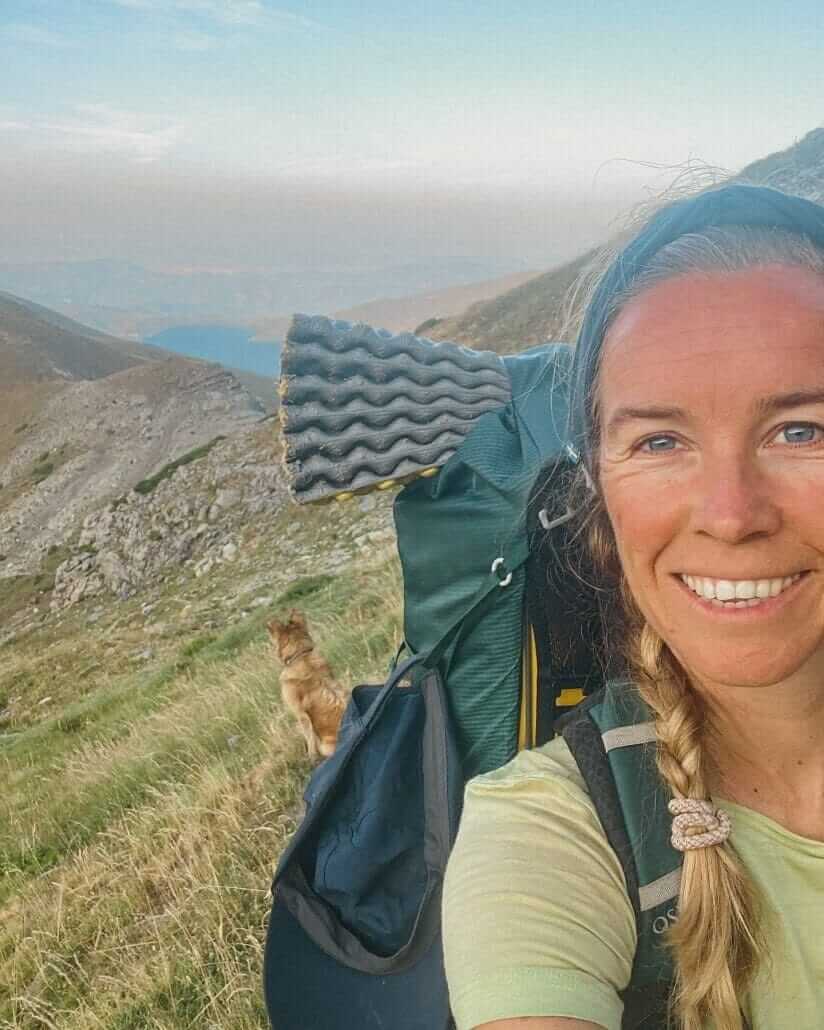
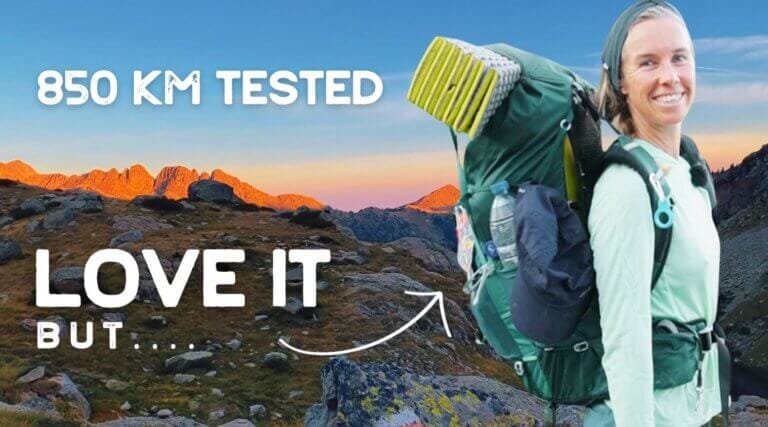
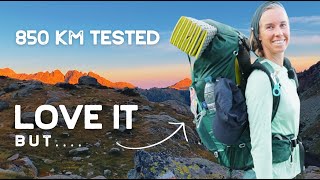
When I filmed my pack walkthrough I was 500 kilometres into the GR11 with 350 to go. This is what I carried for 50 days of hiking and wild camping in the Spanish Pyrenees, through freezing nights, snow, a 40°C heatwave, and the first weeks with my dog. If you're planning a long-distance hike or dreaming of one, this will help you pick smart, pick light and be ready. I've added what works for women hikers and for hiking with a dog, because those two rarely get their own gear list.
Updated September 2026.
The 7 kg setup at a glance: Osprey Eja 48 pack, Big Agnes Fly Creek tent, Therm-a-Rest NeoAir pad, Katadyn BeFree filter, Garmin inReach Mini, Altra trail shoes, Kula Cloth. Base weight 6 to 7 kg without food and water. The full list, with weights, why each item earned its place, and the dog gear, is below.
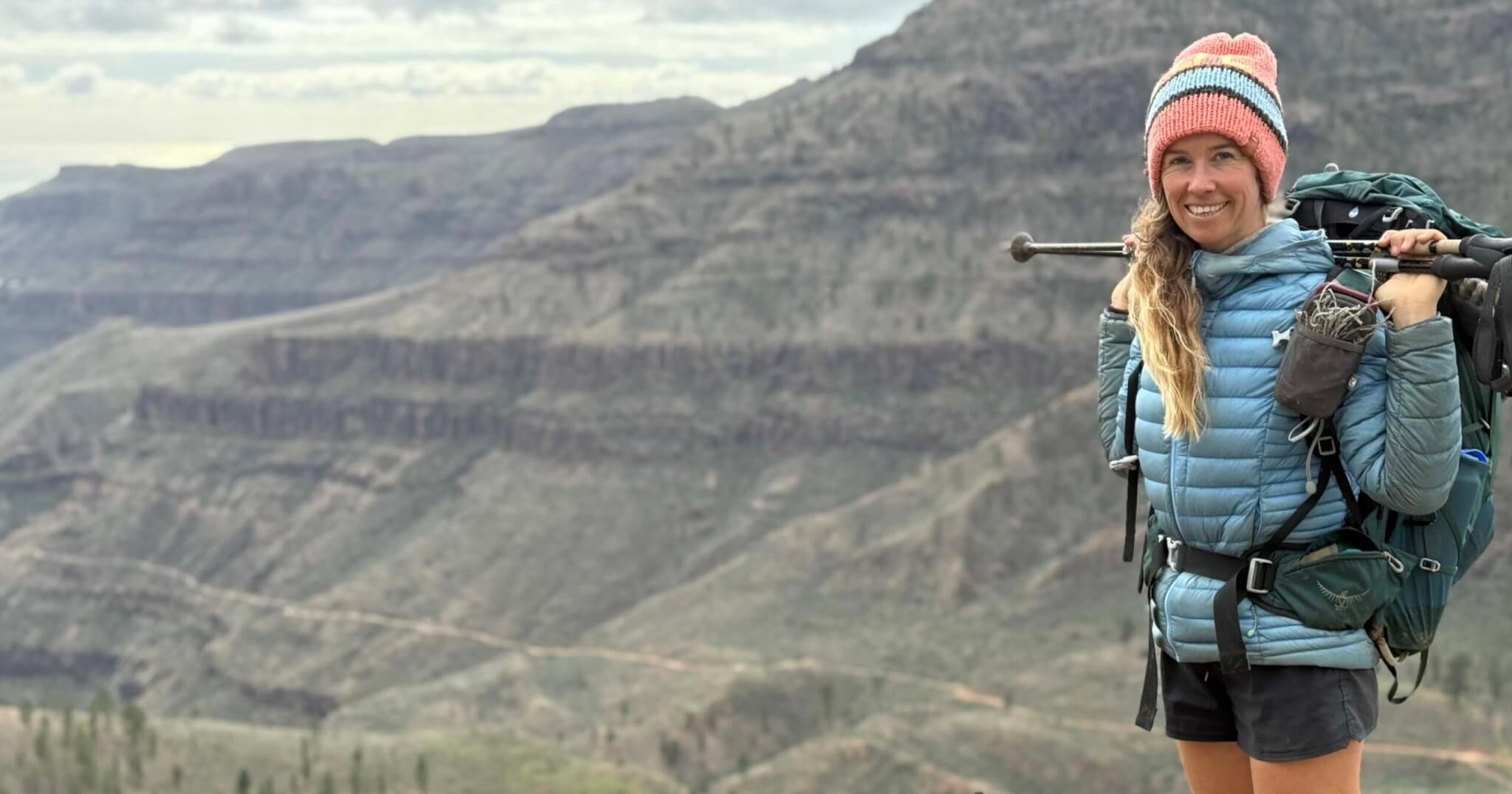
I'm Suzanne, and I live pretty light already. I travel on sailboats as crew or captain, and my van is my home base. But this? This was next level minimalism. Base weight 6 to 7 kg without food and water. Not ultralight, but light enough to move with ease. Because when you carry it over mountains every day, every gram matters.
The gear list in a nutshell
- Base weight: 6-7 kg (without food and water)
- Hiker: Female, 55 kg, 1.70m
- Tested on: 850km GR11 (Spanish Pyrenees), Fisherman's Trail Portugal, GR131, GR7, Picos de Europa, jungle hikes in Dominica
- Conditions tested: Thunderstorms, freezing nights, 40°C heatwaves, alpine terrain, coastal wind
- Dog on board: Yes, for parts of the trails (Wingo, 12kg)
- Style: Mountain huts, tent, occasional guesthouses
In this video I walk you through my pack:
Planning your first multi-day hike? I'm finishing a field guide for exactly that, Your First Hike, out this autumn. Join the waitlist and you'll get it first, at a launch price.
One email when it is ready, with the launch price. You can unsubscribe at any time.
Why go (almost) ultralight? Especially if you're a woman or hiking with a dog
Gear research has been the most time-consuming part of preparing for any of my thru-hikes. I'm officially a hiking nerd. For months before my first long distance trail, I was levelling up my decision-making and minimalism skills, reading, comparing, researching eco and ethical outdoor gear. To bring or not to bring? That is the question :)
Light matters extra if you're small or carrying for two. I weigh 55 kg, so a 10 kg pack is nearly a fifth of me, and every gram shows up in my knees and hips by day five. With Wingo along I carried his food, his balls, his paw wax and his sleeping mat. He carried nothing but joy on his longest dog walk ever. So my own kit had to be the essentials and not much else.
A lot of gear selection is personal preference, but there are some essentials worth investing in once and using for years. Over the years I've invested in a good sleeping mat and sleeping bag (I'm at 3 euros per night now ;)). When you sleep well, the rest is figuroutable.
Ultralight backpacking isn't just about weight. It's about energy, mindset, and moving freely in nature. The lighter you go, the more present and comfortable you'll be.
My complete thru-hiking gear list
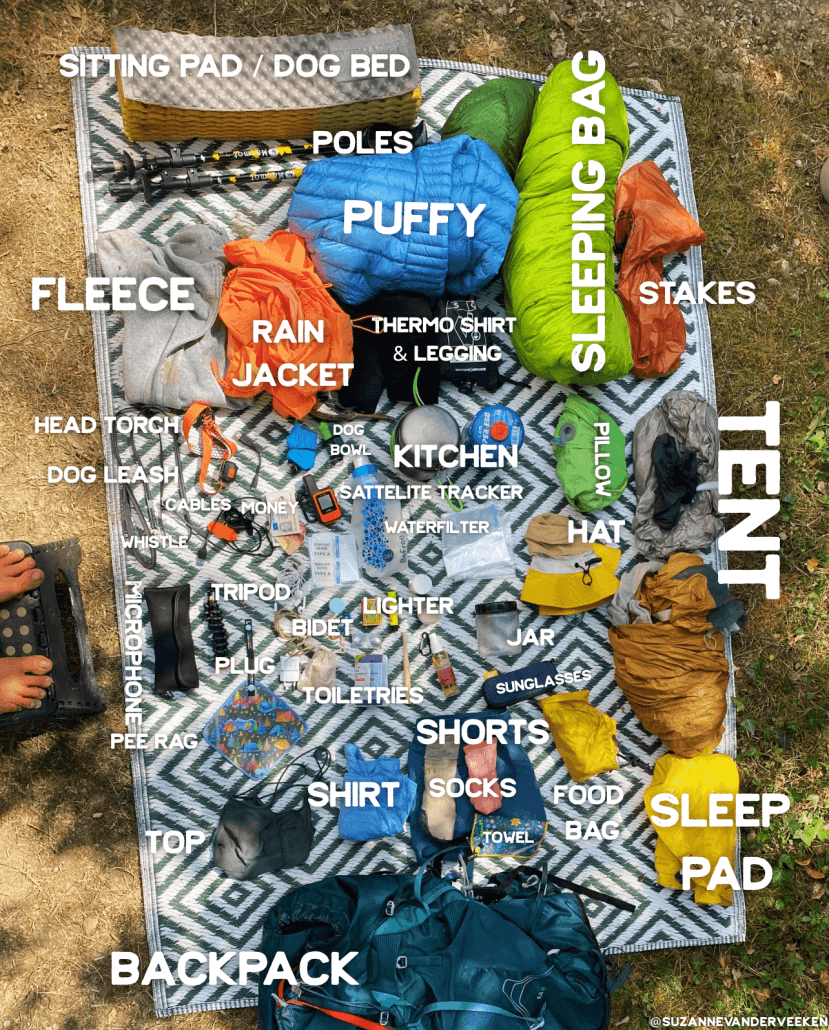
Here's an overview of the essentials I use and love on trail. Every item here has been tested on multiple trails.
Tent
Big Agnes Fly Creek UL2 (used, slightly broken, still going strong). It's Jonatan's old tent, he hiked the Pacific Crest Trail with it. Big Agnes says two persons, and it is, as long as one of them is a dog. I tried it with a friend and Wingo and it was too small for the three of us. If you're solo without a dog, the 1P version saves you even more grams.
For hiking as a couple with a dog, my partner Jonatan and I use the Big Agnes Copper Spur 2P. A little more weight, a lot more livable.
Backpack
Osprey Eja 48L: framed, lightweight, female fit, sustainably made. This is the women's version of the Osprey Exos and the difference matters. Narrower shoulder straps, shorter torso fit, hip belt that actually sits on female hips. If you're a woman hiker, get a women's-specific pack. It never leaves my pack.
Weight hack: I removed the top lid of my pack. Saved me a bit of weight and forced me to carry less. The main compartment closes fine with the roll-top. Not for everyone but it works for me. It's a well-known pack too, so chances are you find one secondhand.
Shoulder Strap Pocket for quick access to phone, snacks, pee cloth, lip balm.
For men, the Osprey Exos 58L is the equivalent. Jonatan, my partner, uses this one.
You can read my full Osprey Eja 48 review if you want the deep dive.
Hiking poles
Telescopic hiking poles, easily adjustable. Such a help with steep descents, scrambles, and balance when you're carrying weight. Your knees will thank you on 50-day trails.
Hack: I wrap a bit of tape around my hiking poles. Duct tape or KT tape. Always handy for taping up a blister, fixing a rip in the tent, or a cracked bottle. No extra weight, no extra pack space.
Sleeping system
Sleeping pad: Thermarest NeoAir X-Lite. Ultralight, blows up fast, really good insulation, warm enough for most 3-season trails. It's a bit of an investment but I'm at about €1-2 per night of use now. Worth every euro.
Sleeping bag: Marmot Hydrogen down bag, rated to around -3°C. I've been cold a few nights but overall happy. If I buy again I'll strongly consider a quilt, more lightweight because it doesn't have a back, and you can increase warmth without compromising weight.
Pillow: Sea2Summit UL pillow. Luxury item, absolutely worth it.
Foam sitting pad: I brought a small foldable foam pad originally for Wingo to sleep on. Now I use it to sit on during breaks, for extra insulation at night under my pad in the cold, and as padding against tree roots or rocks when the ground is rough. Simple, light, multi-purpose.
Clothing (layers over bulk)
Long sleeve sun hoodie: Icebreaker Merino Sun Hoodie. Merino doesn't stink even after days of sweating. Built-in hood saves you a hat on cloudy days. Natural material, breezy, sun protection. Really love this one.
Puffy jacket: Ayacucho down puffy. Dutch brand, they do great things in terms of sustainability and giving back. Warm for the evenings in the hut, cold mountain mornings, and cold nights in the tent.
Rain jacket: Patagonia 3L Rain Jacket. I added this on trail after my first “waterproof” jacket turned out to not actually be waterproof. Expensive mistake. I've put this Patagonia one to the test through a hailstorm, rain showers, and serious wind. Worth every euro. I'll use this for years, for hiking and sailing and walking the dog.
Fleece: simple long-sleeve fleece from Decathlon, plus fleece pants. Sleeping layer, extra warmth if it's really cold, sometimes I hike in it on freezing mornings.
Base layer: Icebreaker Merino Legging and Crew Shirt for sleeping and cold mornings.
Shorts: just simple swimming shorts. I love them because they dry very quick, which matters when you're caught in the rain or swim at a river.
Headband: keeps the hair out of my face and keeps me warm. Super useful, light, take it everywhere now.
Cap: for strong sun. I added this on trail when I got caught in too much direct sun.
My rule: one hiking outfit, one sleeping outfit. That's it. I've brought plenty of silly stuff on past hikes. Six pairs of underwear, a bikini, even a hairbrush once. You don't need any of it :)
Shoes
Trail runners, always. Two sizes too big. Your feet swell on long days, and in the heat, and your toes need room or you'll lose toenails by week 2. I've tried hiking boots. Never going back to them for thru-hiking.
On the GR11 I wore Altra trail runners. Zero-drop, wide toe box, super lightweight, fast-drying. The only downside is you get maybe 1000 km out of them before the soles are done. Not the most sustainable but the performance is great.
Currently I'm wearing Topo Athletic. Similar zero-drop feel, slightly sturdier sole. Both are great, just slightly different. If you're starting out, pick whichever you can try on locally.
Two pairs of hiking socks. I rotate them daily so they can “shave against each other” (sand and grit works itself out) and I get way fewer blisters this way.
Feet hack: merino wool for blisters and pressure points
If you have pain somewhere on your feet, stuff a little bit of merino wool in your sock on the sore spot. The pressure point changes and your feet will be fine in no time. Works magic. No need for the expensive “branded” one from the outdoor store, any piece of merino wool will work. This single trick has saved so many of my trail days.
Cooking gear
Jetboil-style stove (boils water fast, worth the weight for me). I have this Optimus.
Decathlon gas canisters (available almost everywhere in Europe). They have extra small ones.
Coconut spoon.
Tea sifter (I'm a tea person, this gets reused for fresh herbs I find on trail too).
Cold-soak jar for overnight oats (saves gas in the mornings).
You can go stoveless to save weight, but I like a hot meal and hot coffee at the end of a long day. A stove is worth its weight if it makes you happy and well-fed. That morning tea is one of those things that just brings so much joy on trail.
Water system
Katadyn BeFree water filter. Ultralight, fast, reliable. I've used this one on multiple trails and it just works.
Lightweight plastic bottle (would swap for BPA-free next time).
For more serious water needs (heavy algae, sediment, chemical contamination), I love the Maunawai filter. Slightly heavier but much better filtration. I use it on the boat and in the van.
Toiletries and hygiene
DIY toothpaste and a DIY face oil moisturizer (in tiny reusable containers).
Toothbrush.
Tongue scraper.
CuloClean portable bidet. You screw it onto your water bottle. Cleaner than toilet paper, less waste, kinder to nature.
Kula Cloth pee rag + Pee rag leash. More on this in the women's section below.
Spirulina, electrolytes, multivitamin.
Sun cream.
Lip balm (I burn fast, this saved me many times).
Earplugs.
Blister plasters.
A small microfibre cloth I use like a towel to wash my face.
No soap, no shampoo. I've stopped bringing them. Rinse in streams, natural lakes, rivers. Hair is fine, skin is fine. Less weight, zero microplastic pollution in the water.
Here's a video on my Hygiene Kit & Hacks on Trail.
Electronics and navigation
Garmin InReach Mini. Satellite tracker, SOS button, weather updates. Absolute lifesaver in the Pyrenees when I couldn't get a weather forecast any other way. If you're hiking alpine trails solo, do not skip this.
iPhone 11.
10,000mAh Nitecore power bank.
Head torch and cables.
Sony ZV-E10 camera (added later, after Wingo left the trail) with a camera clipper for the backpack.
Hiking with a dog: the full gear list and what I wish I'd known
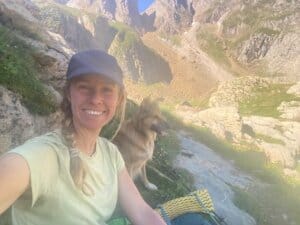
Wingo was a legend on the GR11. He constantly checked in, running between me and my hiking buddy, guarding us from cows and creatures. He probably walked the trail four or five times just to make sure we were both okay. Dog barking was the sound of the night (he kept the bears away, he says). After a few weeks, when the stages got higher and hotter, he went to stay with my parents, and I'm glad I listened to him. If you're thinking of bringing your dog on a long trail, here's the gear and what I'd tell you first.

Dog gear I always carry
Sleeping mat for the dog: a foldable Thermarest pad, cut to size. Dogs sleep much warmer on an insulating layer, especially in mountain huts or cold tent floors.
A lightweight leash.
Pawwax. Essential for rocky, hot, or salty terrain. I put it on Wingo's paws in the morning and it creates a protective layer. Prevents cracked pads, abrasions, burns from hot sand or rock.
Collapsible food and water bowls. I have 2 of these Nitesize ones, super light
Dog food. This is the heavy part. On a multi-day trail like the GR11, I carried 3-4 days of food at a time and resupply in villages. Good extra bit of weight so it was a must to keep my packweight down. I also carry the Advance supplements for him which are good for his joints. Superlight but super good for him.
Dog first aid: a tiny kit with vet wrap, a tick remover, saline, antiseptic and whatever meds your dog takes. We've met ticks, thorns, broken glass and farm dogs on trail, so be ready.
Tips for hiking with a dog on long distance trails
Train the distance gradually. Dogs, like people, need conditioning. Don't start with a 20km day. Build up over weeks.
Watch paws constantly. Check pads each evening for cuts, abrasions, burns, thorns, or tar. Early action prevents trail-ending injuries. Pawwax worked great here!
Respect their pace. If your dog is slowing down, take more breaks. Not every dog is built for 20+ km days on hard terrain.
Know when to pause. Extreme heat, altitude, very long road sections, or lots of farm dogs can be too much. Wingo left the trail partway through the GR11 because it was hot and hard on him. I'm glad I listened.
Plan for dog-friendly accommodation. Not all hostels and guesthouses accept dogs. This shapes where you can sleep. Bringing a tent solves a lot of this. I choose my hikes where I can camp.
Know the trail rules. Some trails ban dogs. Some require them on a leash. Some have farm dogs that can be territorial.
I wrote a whole separate post on how I prepared for the GR11 with my dog if you want the full deep dive. And in this video I share more about it:
For women thru-hikers: the gear that matters
A few things I'd tell a woman going into her first long hike, because they took me a while to figure out.
Get a women's-specific pack
The Osprey Eja 48L is made for a female body: narrower straps, a shorter torso, a hip belt that sits on your hips instead of above them. On 10-hour days that is the difference between a sore back and no back pain at all (I had none in 850 km). Deuter, Gregory and Granite Gear make women's versions too. Try a few on with weight in them before you commit.
Your period on trail
I carry a menstrual cup (15 grams, it's on the list). My period arrived in the first week of the GR11 and threw my whole rhythm, and a cup at least means nothing to carry out and nothing to run out of. Rinse it with filtered water. Bring period underwear or a cloth pad as backup for the days you can't clean it properly.
If you prefer tampons or pads, that's totally fine. Just pack enough to cover a full cycle plus buffer, in a separate dry bag, and carry out the used ones in a sealed bag until you hit a trash bin in town.
Pee cloth and portable bidet
I carry two Kula Cloths. One is the pee rag, to catch the drops so underwear stays cleaner a little longer. The other I use like a towel to wash my face. They're antimicrobial and dry on the outside of the pack in the sun, and it means no toilet paper left behind bushes, which you see on every busy trail.
Pair it with a CuloClean portable bidet (screws onto your water bottle) and you've got the cleanest, most eco-friendly toilet setup possible on trail.
Hack: clip the pee rag to a bouncing leash on your shoulder strap so you can pee with your backpack on. You just pull it out, no fumbling. That one changed my days :)
Staying warm, staying cool
I've been cold a few nights in a bag rated to minus three, and a cold night of no sleep costs you the next day. If you're choosing between a warmer and a lighter bag, go warmer. I sleep in merino thermals even in summer, and next time I'd take a quilt.
Safety
If you're hiking solo, carry a Garmin InReach Mini. It sends my position every two hours so mom always knows where I am, I can message with it, and I can check the weather when there's no signal for days. I bought it for sailing and it's useful for any wild adventure. Most solo hiking accidents are falls and sprains, not crimes, and this is what gets help to you.
Also: a headtorch with red light mode for night bathroom trips. A whistle on your pack. Trust your gut about camping spots.
Want the full thru-hiking prep?
Jonatan and I are putting together everything we wish we'd known before our first long hikes: training, route planning, mindset, logistics, hiking with a dog, solo female hiking. Join the Your First Hike waitlist for early access.
How I tested this gear: 850 km on the GR11
Most of this gear list got its serious testing on the GR11 trail across the Spanish Pyrenees. 850 km from the Atlantic Ocean to the Mediterranean Sea, 50 days, solo with Wingo for the first few weeks, then solo after he went back home. Tent most nights, mountain huts (cabanas) sometimes, the occasional guesthouse.
Conditions tested this kit hard: thunderstorms, freezing nights at altitude, 40°C heatwaves in the lower valleys, long alpine days with snow crossings in June. A few things I swapped out mid-trail:
- Rain jacket: my first “waterproof” jacket turned out not to be. Bought the Patagonia 3L in Pamplona. Trail lesson: don't skimp on rain gear.
- Rain pants: ditched them. Wet legs dry faster than wet rain pants.
- Camera: added the Sony ZV-E10 once Wingo left the trail and I had spare weight capacity.
I ended the hike with pretty much the same pack, and I used everything nearly every day. The only thing I never touched was the repair kit, which I hope stays that way.
Gear lessons after 2,500+ km of thru-hiking
A few things I've learned over time:
- You need way less than you think. Whatever you bring, you carry every day across every mountain. If you don't use it, ditch it or give it away.
- Always test your gear before the trail. Sleep in your tent, use your water filter, cook with your stove. A long trail is not the place for first tries.
- You don't need to buy new. I used what I had, looked secondhand, and borrowed. There's so much great gear out there that doesn't need to be brand new.
- Don't bring what you might use, bring what you actually use.
- On remote trails like the GR11 it's not easy to find gear if you need to replace something. Plan ahead and check your kit before you start.
- If you hike with a friend, carry your own basics in case you have different rhythms and needs.
- Your pack evolves with every trail. I've brought plenty of silly stuff before, six pairs of underwear, a bikini, even a hairbrush (I made a video about things NOT to bring actually). Your kit gets smarter every time.
- The lighter your pack, the more present and comfortable you'll be on the trail.
- Framed backpacks can be just as light as frameless ones if you choose well.
- A stove can be worth its weight if it makes you happy and well-fed. I'm not giving up my morning coffee :)
- Layers over bulk. Think versatile and breathable.
- Hike your own hike. Everyone's body, style, and comfort zone is different.
Navigation and route planning
On every thru-hike I run two apps. AllTrails with the maps downloaded offline (the paid version does that) is what I follow. Maps.me is the free backup, and for alpine trails I load the official GPX track into it too.
Try AllTrails free for 7 days. Really useful for finding shorter trails around you too, or planning day hikes to warm up before a thru-hike.
Staying connected on trail
If you're hiking outside your home country and don't have European roaming, an eSim is the easiest way to stay connected. You download it on your phone, no SIM card swap, works in most European countries. I use Airalo and it has saved me multiple times for checking weather, booking emergency accommodation, and messaging home.
Community and resources for thru-hikers
Some of my favourite resources and communities for fellow thru-hikers:
Ocean Nomads is the community I founded: sailors, vanlifers and thru-hikers who help each other out. On the Fisherman's Trail I was hosted by members three times. Membership costs less than a hostel night, and I'm in there myself.
TrustedHousesitters is how I fund the weeks between trails: sit pets and houses for free accommodation. Good for the training weeks before a thru-hike and the recovery after. Browse sits for free, and code TRUSTED15 gets you 15% off a new annual membership (click the link first so it tracks).
Related reading: trails and prep
If you want to see these gear choices applied to specific trails, or go deeper on preparation:
- How I prepared for hiking the GR11 solo with my dog
- Osprey Eja 48 review: my favourite thru-hiking backpack for women
- The Waitukubuli Trail in Dominica: hiking the Caribbean jungle
- Fisherman's Trail Portugal guide (coastal, dog-friendly, beginner-friendly thru-hike)
Learn from a pro thru-hiker (my partner Jonatan)
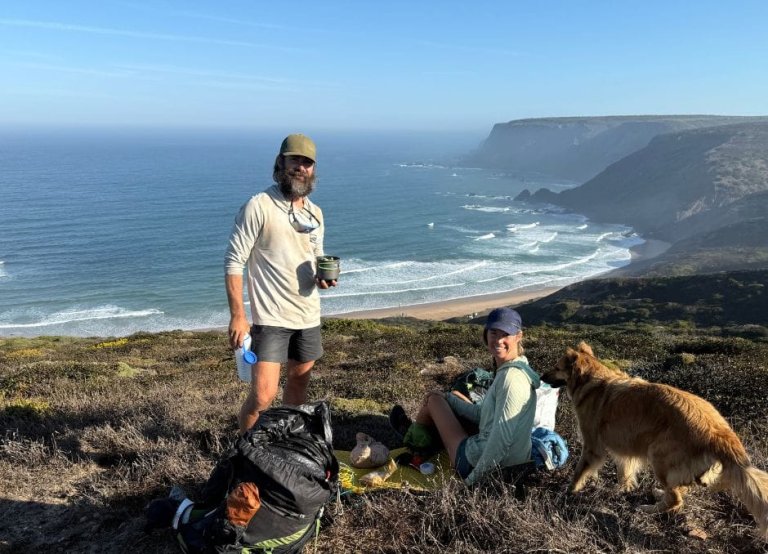
My partner Jonatan is a very seasoned thru-hiker. He's walked the Pacific Crest Trail, Appalachian Trail, done the GR11 in half the time I did, and many more long trais. His pack is even lighter than mine, and we pack very differently. Which is kind of the point. Everyone's body, style, and comfort zone is different. You have to hike your own hike. No fancy gear. He literally carries the same stuff for 1000s of miles.
If you're gearing up for your first long distance hike or want to lighten your load, I hope this post has been helpful. Drop your questions in the comments and I'll try my best to help. And remember: Perfect gear doesn't exist. What matters is getting out there. The trail will teach you.
Everything else I use on the road and on trail is on my travel resources page.
Frequently asked questions
What base weight should I aim for on a thru-hike?
Under 10 kg base weight (without food and water) is a solid target for most thru-hikers. Under 7 kg is considered ultralight. My own setup is 6-7 kg. Beginners often start at 12-15 kg and trim down with experience. Don't stress about hitting ultralight numbers your first trail. Just leave behind what you won't use.
Can women just use men's hiking gear?
For most items, yes. Sleeping bags, tents, cooking gear, electronics, all unisex. For your backpack, I strongly recommend a women's-specific fit. Different torso length and hip structure matters a lot over long days.
How do you manage your period on a thru-hike?
Menstrual cup is the easiest option, no trash to carry out, reusable for years. Bring a backup (period underwear or cloth pads) in case you can't clean your cup well one day. Disposable tampons or pads work too, just pack enough and carry out the used ones in a sealed bag.
What gear do I need specifically for hiking with a dog?
Beyond your normal gear: a sleeping pad for the dog, lightweight harness with a handle, pawwax for paw protection, collapsible food and water bowls, tick repellent, small canine first aid kit, poop bags, and enough food between resupply points. Plan for 300-500g of food per day depending on dog size.
Do I need a stove on a thru-hike?
No, but it's nice. Some hikers go stoveless and eat cold-soaked oats and wraps to save weight. I bring a stove because a hot meal and hot coffee at the end of a long day is a morale booster I'm not willing to skip.
Is it safe for a woman to thru-hike alone?
Yes. Most trail injuries are accidents (falls, sprains, exposure), not crimes. That said, prep matters: tell someone your route, carry a satellite communicator like the Garmin InReach Mini, trust your gut on camping spots, and build experience on shorter trails first.
What's the lightest single piece of gear that made the biggest difference?
The Kula Cloth pee rag. Weighs almost nothing, and no more toilet paper left in the bushes. Every woman hiker should have one.
How long does thru-hiking gear last?
Depends on the piece. Trail runners: 800-1000 km. Sleeping bag with good care: 10+ years. Tent: 500-1000 nights with decent care. Backpack: 5-10 years. Buying quality gear once and maintaining it is better than cheap gear replaced yearly, both for your wallet and for the environment.
Want the full gear list?
I made a full video walking through every item in my pack. Watch it here on YouTube. You'll see how I fit everything I needed for 50 days into a 48L pack, including gear for steep alpine terrain and full independence.
Click here to get the complete gear list with weights delivered to your inbox.
Let's connect
I share many more hiking tips, slow travel stories, and trail life updates on Instagram and YouTube.
Follow me on Instagram
Subscribe to my YouTube channel
Join the newsletter for slow travel tips
Say hi on Facebook.
Got questions about thru-hiking gear, solo hiking, or hiking with a dog? Drop a comment, I'd love to hear from you.
Curious what the GR11 trail itself was like?
Here's the full video of hiking 850km across the Spanish Pyrenees. It'll give you a real sense of what a long distance hike feels like day-to-day. This is the first video of a series, I'm still working on today.
Disclaimer
Wild at heart? Let's be friends.
Join me on YouTube for slow travel adventures by van, sail and on foot.
Or get my new stories by email, every couple of weeks.
Ocean Nomads is the community I founded, for people who want to live a little wilder, explore a little further, and do it with good people.
For deeper trail stories and the behind-the-scenes, I write on Patreon.
Explore more
Read next
 Osprey Eja 48 Review: Tested on 850 km of the GR11 Pyrenees
 Best hiking apps: the 4 I use after 2,500 km thru-hiking
 GR11 With My Dog: Trail Diary, Stages 1-11 (Atlantic to Aragon)
 All my thru-hiking stories
Watch on YouTube

I share my experiences, research, and personal opinions on this blog to encourage a more conscious and adventurous life close to nature. Some articles may contain affiliate links. If you decide to purchase something through those links, I may earn a small commission at no extra cost to you. This helps support the time and work that goes into creating these guides, stories, and resources.
I only recommend tools, gear or services I have used myself and stand behind. Whenever a product was gifted or a collaboration took place, I will clearly mention it. All opinions remain my own.
The information shared here is based on personal experience and research, but it should not replace your own judgement, training, or preparation. When travelling, sailing, hiking, or exploring the outdoors, it is always your responsibility to have the appropriate knowledge, skills, and equipment to stay safe.
As always, the goal of this website is simple: help you explore the world more consciously, connect with nature, and protect the places we love.