


Table of Contents
- Part 1: Before You Go
- Planning your trip
- Where to stay
- What to pack: The Wildful Travel Kit
- 14. Pack light
- 15. Bring a refillable water bottle. With a filter.
- 16. Reusable cutlery, straw, bag
- 17. Reef-safe sunscreen. Non-negotiable.
- 18. Or make your own. It's actually easy.
- 19. Plastic-free toiletries
- 20. Travel insurance: SafetyWing
- 21. eSIM instead of buying SIM cards
- 22. VPN for safety on dodgy WiFi
- 23. Pack for a Purpose
- 24. Travel docs digital
- Part 2: On the Trip
- Part 3: After You Get Back
- 7 Mistakes Eco Travellers Still Make (Even The Well-Meaning Ones)
- Frequently Asked Questions
- What is eco-friendly travel?
- What is the most eco-friendly way to travel?
- What's the single most impactful eco travel change I can make?
- Is sustainable travel expensive?
- How can I travel sustainably on a budget?
- Is flying always bad?
- Is reef-safe sunscreen actually different?
- How do I find genuinely eco-friendly accommodation?
- How do I find ethical, low-impact tours?
- What goes in a zero-waste travel kit?
- More from the Wildful library
Eco travel tips at a glance
- Tips inside: 50 practical actions, organised by stage of trip
- For: travellers who want to lower their impact without losing the fun
- Best change you can make: travel slower, by foot, bike, or sail
- Highest-impact swap: bottled water to a filtered bottle (saves +/-200 plastic bottles per trip)
- Most overlooked tip: book direct with the accommodation, not the platform
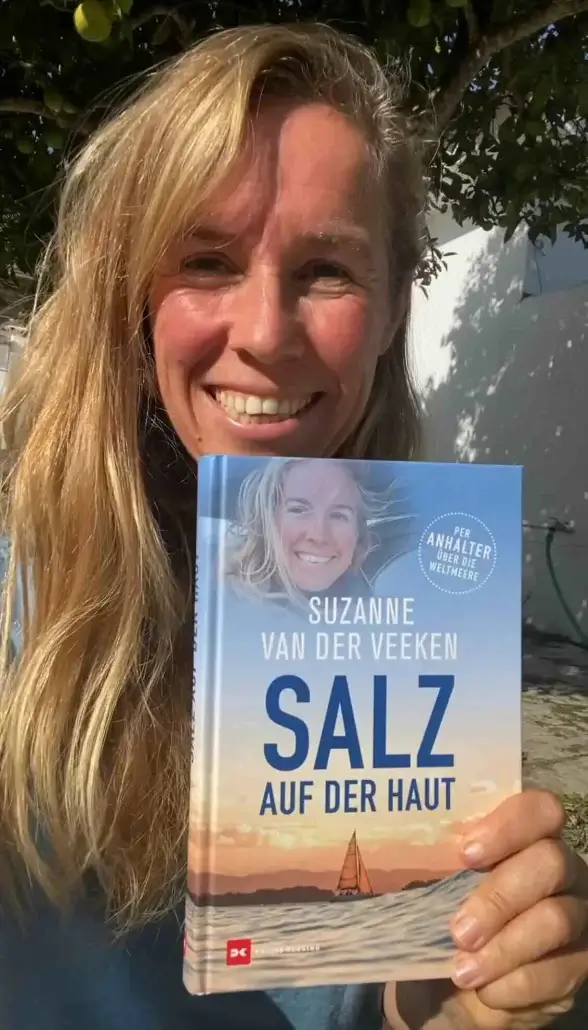
- Author: Suzanne van der Veeken, sailor, thru-hiker, vanlifer, 10+ years of low-impact travel across 6 continents
- Last updated: April 2026
If you're reading this, you're probably one of the lucky ones. You can travel. You've eaten exotic things, swum with magnificent things, and watched sunsets on coasts most of the world will never see.
You've also seen trash on beaches. Begging children. Damaged corals. Sharks on the market. Plastic where there shouldn't be plastic. The other side of the postcard.
I've been a full-time nomad for over a decade. Sailing across oceans, thru-hiking 850 km of the Pyrenees with my dog, vanlifing through Morocco, walking the Fisherman's Trail in Portugal, working with communities along coasts. Long enough to know that travel can either trash a place or help it. There is no neutral. Tourism alone now produces around 9% of global emissions, and is growing faster than the rest of the economy. Which means how we travel matters more every year, not less.
The good news: small choices, made consistently, add up. Most of them also save you money and give you a better trip.
Here are 50 things I actually do, organised by where in the trip you are. Skim, pick the ones that fit, leave the rest. The goal is not perfection. It's progress.
Want the framework first? Start with the 7 R's: Rethink, Refuse, Reduce, Reuse, Repair, Repurpose, Recycle. Everything below sits inside that. And if you'd rather watch than read, I share most of this in video form too, come hang out on my YouTube channel and on Instagram.
If you only do 5 things
50 tips is a lot. If you only have time for the highest-impact moves, do these. They're the ones I'd tell my own family to start with:
- Travel slower, fly less. One trip of three weeks beats three trips of one week. Always.
- Pack a filtered water bottle. Saves around 200 plastic bottles on a long trip. The single highest-impact swap on the list.
- Book locally owned, book direct. Skip the booking platforms when you can. Your money goes into the community instead of into a foreign middleman.
- Use reef-safe sunscreen. Standard sunscreen is now banned in 8+ destinations because it bleaches corals. Zinc oxide only.
- Skip the wildlife “experiences.” No tigers, no elephants, no chained monkeys, no turtle-grabbing tours. If the animal is a prop, walk away.
Do those five and you've cut more impact than 90% of travellers. The other 45 are bonus points.

Part 1: Before You Go
Planning your trip
1. Travel slow
One place, deeply. Not five places, shallowly. Slow travel is the single biggest impact-reducer in this whole list because it cuts your transport emissions, supports local economies more, and gives you a better trip. Here's why. Here's how.
2. Plan for shoulder or low season
You'll be welcomed properly. Local businesses don't have to pivot to alternatives like selling mantarays or destructive fishing to survive the dry months. The destination is often more beautiful (greenery!). And it's cheaper. The media tells you “rainy/hurricane season, don't go”. Usually it's the best time.
3. Choose a destination that's trying
More places are seriously committing to sustainability. Support them. Browse the Green Destinations Top 100 for inspiration.
4. Travel without a fuel-burning machine
Hike a long-distance trail. Bike across a country. Catch a sailboat ride. Pitch a tent and don't go anywhere for a week. Avoid huge cruise ships, they're highly polluting, distress marine life, and dump 5,000 people on a small island for 6 hours.
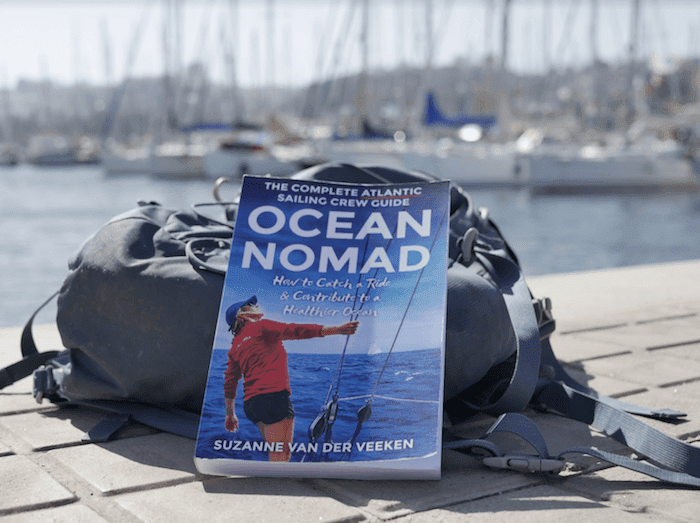
If you've ever wanted to sail across an ocean as crew, that's exactly what I teach inside Zero to Ocean Nomad, the course that takes you from “no experience” to confidently stepping onto a sailboat as crew. We're crossing the Atlantic together winter 2026/2027. Come along.
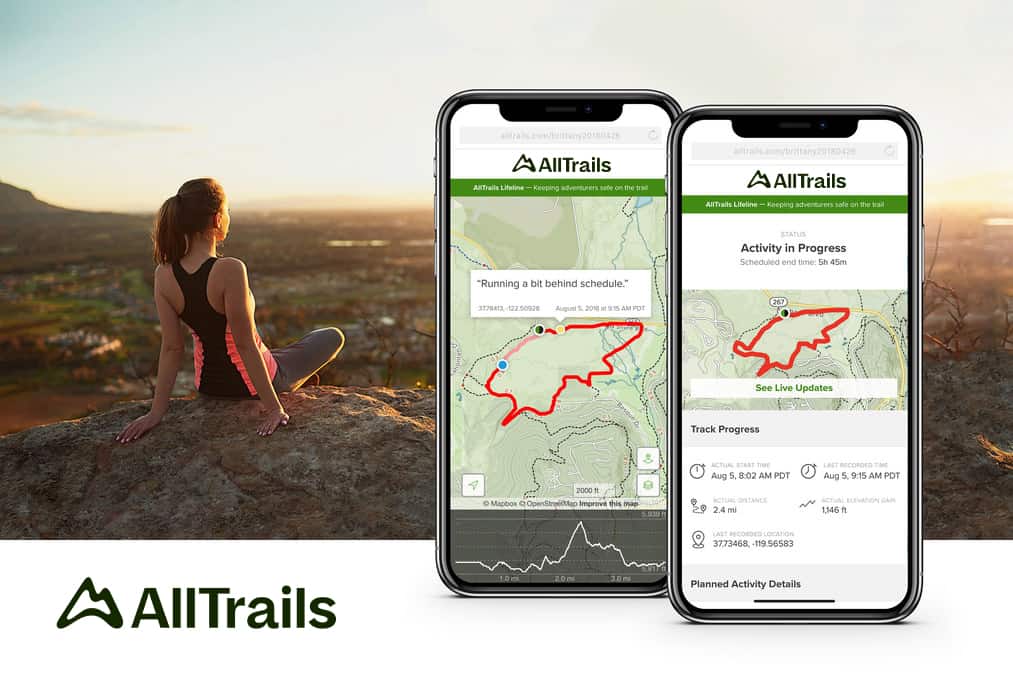
For thru-hiking inspiration: my Fisherman's Trail diary (Portugal), my 850 km across the Pyrenees on the GR11, or the Waitukubuli Trail across Dominica. To find a trail near you: AllTrails is the app I use everywhere, with offline maps for over 400,000 trails worldwide. For deeper backcountry navigation (topo maps, GPS tracks, off-trail), Gaia GPS is the more serious tool. They complement each other. Full comparison in my review of the best hiking apps for thru-hiking. For really remote stuff (mountain ranges, ocean crossings, deserts) I also carry a Garmin inReach Mini so I can SOS or message family with no phone signal. Worth every euro the one time you need it.
Wondering why I keep walking these long trails? I made a video about it:
Not ready to plan a whole thru-hike yourself? Self-guided walking holidays are a great middle ground, you walk on your own, but the operator books the small guesthouses and shuttles your bag. Browse self-guided and guided walking tours on TourRadar for low-impact, foot-powered options around the world.

5. If you do fly, plan smart
Pick somewhere closer. Stay longer. If you fly far, take the most direct route, landings and take-offs are the worst part. Fly during the day (sun reduces contrail emissions). Pick newer aircraft if you can. Tools: flightconnections.com for direct routes, Rome2Rio for non-flying alternatives. For ferries specifically (often replacing short-haul flights in southern Europe), Ferryhopper is way cleaner and cheaper than the airline route.
Heading to the Canary Islands? Here's how to get there without flying.
6. Don't plan too much
Leave space for the unplanned village, the random conversation, the boat captain who asks if you want to come along. The best parts of any trip are the parts you didn't book.
Where to stay
7. Book direct with the accommodation
The local owner notices an extra dollar. Booking.com doesn't. Once you've found the place online, send them a direct email or WhatsApp. Why spending local matters more than you think.
8. Book locally owned, locally staffed
Your money goes into the community instead of into a foreign owner's next holiday house. Homestays, family guesthouses, small B&Bs. Better experience, better impact.
9. Look for ecolabels
Certifications like Green Key and Travelife mean the place is making real effort. Find ecolabeled places via BookDifferent.
10. Try housesitting
Free accommodation, real connection with a place, and you take care of someone's pet while they're away. Win across the board. Trusted Housesitters is the platform I've used and recommended for years, solid in 100+ countries.
For more options including free and pay-to-sit platforms, see my 10 best house sitting websites guide, including boat-sitting, which gets you onto sailboats for weeks at a time.
11. Volunteer your way around
Work a few hours a day in exchange for food and a bed. Workaway, WWOOF (organic farms), or HelpX. You learn a real skill, contribute, and travel almost free.
If you want to volunteer with us directly, we run a volunteer project on a Caribbean island paradise through Ocean Nomads, real ocean impact work, in real ocean places. And inside the Ocean Nomads community itself, members along trails and coasts often welcome and host each other, fellow sailors, vanlifers, hikers. Cheaper than any platform, and you stay with someone who actually lives this way.
12. Skip the air-con
Adapt to the local air. AC eats power, dries out your sinuses, and is often why people get sick on holiday. Open the window. Listen to the night sounds. Your body adjusts in 2-3 days.
13. Try wild camping or land sharing
Where it's legal, sleeping outside is the lowest-impact way to spend a night. For an organised version: Campspace connects you with people who share their land for camping, gardens, farms, off-grid spots.
If you're vanlifing or sailing, a dry compost toilet eliminates the chemical waste tank entirely and lets you stay off-grid for weeks. After testing several myself, I wrote a full guide to the best compost toilets for vans, campers and sailboats. The Kildwick is the one I use.
What to pack: The Wildful Travel Kit
The kit at a glance
After 10+ years on the road, this is what I actually carry. Three tiers, depending on how deep you're going:
Core (the must-haves)
Filtered water bottle · reusable spork, tote, straw · solid soap & shampoo bars · reef-safe sunscreen · plastic-free toiletries · digital travel docs · eSIM
Nice-to-have
DIY sunscreen ingredients · menstrual cup · portable bidet · ultralight e-reader · single USB-C charger · VPN
Expedition / off-grid
Garmin inReach Mini (satellite SOS) · compost toilet (van/sailboat) · serious water filter · ultralight tent · pee cloth
Detail on each, with the brands I actually use, below.
For the full version of my packing kit, see my full sustainable travel packing kit. Below are the eco-friendly travel essentials that matter most.
14. Pack light
Saves the plane fuel. Saves your back. Forces you to make better choices. If you've never gone full ultralight, my ultralight thru-hiking gear list shows what 850 km of trail taught me about how little you actually need.
Two small swaps with big return: a Kobo Clara e-reader (made from recycled ocean plastic, holds thousands of books, weighs nothing) replaces every paper book you'd carry. And a single Anker Nano USB-C charger charges everything: phone, e-reader, headphones, laptop. One charger, one cable, less e-waste, lighter bag.
15. Bring a refillable water bottle. With a filter.
This is the single highest-impact swap on the list. A trip to Asia can mean 40+ plastic bottles per person. With a filtered bottle, zero. Three I trust:
- Lightweight & cheap: LifeStraw filter bottle, works almost everywhere.
- Fast & rugged: Katadyn BeFree, my pick for hiking and trips where I'm scooping from rivers.
- Home + travel: Maunawai Kini, what I use in the van as the everyday filter (review).
For a deeper comparison: 5 portable water filtration solutions and 10 cheap plastic-free water alternatives.

16. Reusable cutlery, straw, bag
A titanium spork weighs nothing and replaces a plastic spoon every meal. A bamboo or steel straw replaces hundreds. A folding tote replaces hundreds of bags. Pack once, use forever.
17. Reef-safe sunscreen. Non-negotiable.
Standard sunscreen contains chemicals (oxybenzone, octinoxate) that bleach corals and mess with your hormones. An estimated 8,000-16,000 tons of sunscreen washes into reef areas every year, and 8+ destinations have now banned it: Hawaii, Palau, Bonaire, Aruba, Key West, US Virgin Islands, parts of Mexico, and Thailand's marine parks. Stick to non-nano zinc oxide formulas. My picks:
- All Good Zinc Butter SPF 50+, works for face, kids, water sports
- Raw Elements Face & Body Tin, plastic-free packaging
- Badger Coral Reef Safe SPF 40
- Ohm Collection Sun Safe SPF 30, my European pick
18. Or make your own. It's actually easy.
Three ingredients (zinc oxide + coconut oil + shea butter). Ten minutes. Lasts months. Full DIY sunscreen recipe with step-by-step. The base ingredient: non-nano zinc oxide powder.
19. Plastic-free toiletries
Solid shampoo bars, soap bars, toothpaste tabs. The chemicals in conventional toiletries, fragrance, microplastics, hormone disruptors, end up in waterways and in you. My everyday workhorses:
- Dr. Bronner's Pure-Castile Soap, body, hair, dishes, laundry, all of it
- Aleppo soap, gentle, traditional, biodegradable
- Plastic-free shampoo recommendations, my full guide
- DIY toothpaste recipe, three ingredients
Switch your toothbrush too: why I went from bamboo brush to a miswak stick.
Two more swaps that quietly change everything:
- For women travellers: a menstrual cup replaces literally hundreds of tampons or pads per year. Less waste, fewer “where do I find these here” panics. Once you switch you don't go back.
- For everyone: a CuloClean portable bidet. Screws onto any bottle, replaces toilet paper, fits in your pocket. Especially good for hiking, vanlife, and countries where flushing TP isn't an option anyway.

20. Travel insurance: SafetyWing
For nomad-style travel, long, multi-country, mixing work and adventure, SafetyWing is what I use. Monthly subscription, covers 180+ countries, designed by nomads for nomads. Way more flexible than traditional travel insurance.
21. eSIM instead of buying SIM cards
One less plastic card per country. Airalo activates a data plan in any country in 5 minutes from your phone. I use it everywhere.
22. VPN for safety on dodgy WiFi
Less environmental, more practical: airport / café / hostel WiFi is wide open. Surfshark is what I run on my laptop and phone.
23. Pack for a Purpose
Check Pack for a Purpose before you go, communities at your destination might need pencils, school supplies, basic medicine. Costs you nothing, means a lot.
24. Travel docs digital
Save the trees. Save the kilos. Boarding passes, hotel reservations, travel insurance docs, all on your phone. The only paper you need is your passport.
Prefer watching to reading?
I make videos about most of this stuff, slow travel, plastic-free packing hacks, vanlife in Morocco, thru-hiking with a dog, sailing across oceans. New videos every week.
Subscribe to my YouTube channel and come along for the ride.
Part 2: On the Trip
Getting around
25. Share rides, taxis, boats
Lower emissions per person, lower cost per person. Way better stories.
26. Explore by bike, kayak, SUP, foot
You see ten times more than from a tour bus window. You meet the people you wouldn't have met. You earn the place. AllTrails works for cycling routes and water trails too, not just hiking, so you can plan a low-impact day from your phone wherever you are.
27. Take responsible tours
The cheapest is rarely the best. Read reviews. Check ecolabels. Talk to operators. Do they pay locals fairly? Do they respect wildlife? Do they limit group sizes? My own sailing trips are here, small, intentional, low-impact.
For multi-day adventures with smaller-group, ethical operators, TourRadar's eco-tour collection is a useful starting point, you can filter by group size, sustainability commitments, and operator ratings before you commit. For day activities at your destination (a kayak tour, a snorkel trip, a guided coastal walk), GetYourGuide helps you compare smaller, locally-run operators in one place. Same rules apply: read the reviews, check the group size, skip anything involving captive animals.
28. Skip the airline meal & take-away tour lunch
Each one comes wrapped in 5-10 plastic items. Skipping the airline meal also reduces jetlag, your body syncs faster to the destination if you arrive a little hungry. And those tour-operator lunchboxes? Bring your own container, ask for it inside.
Eating & drinking
29. Eat in, don't take away
Sit down at the small local cafe. Talk to people. Skip the plastic packaging. If take-away is unavoidable, bring your own container or skip the lid. The local fast-food chains make every place look the same. Resist them.
30. Eat plant-forward
Not perfect. Just more. The food choices you make on the road have more impact than your flight. Local fruits, vegetables, grains, legumes, usually fresher, cheaper, and lower-impact than imported meat. You don't need to go full vegan to make a difference. Just eat less of the things that take the most out of the planet, and more of the things that don't.
31. Reconsider fish (especially the big ones)
90% of the big fish (tuna, swordfish, marlin) are gone. How we're emptying the ocean. If you do eat fish, eat small (sardines, anchovies, mackerel) and ask how it was caught. Better yet: try seaweed as a source of omega-3, same nutrients, none of the destruction.

32. Local market over supermarket
Skip the imported apple. Try the weird local fruit you can't pronounce. Your money goes to families instead of multinational supply chains, and you have a better breakfast.
For the next-level version: learn what's edible in the wild around you. Food for Free (Collins Gem) is the pocket guide I carry. Free food, ancient skill, deeper connection to the place. My tips on foraging.
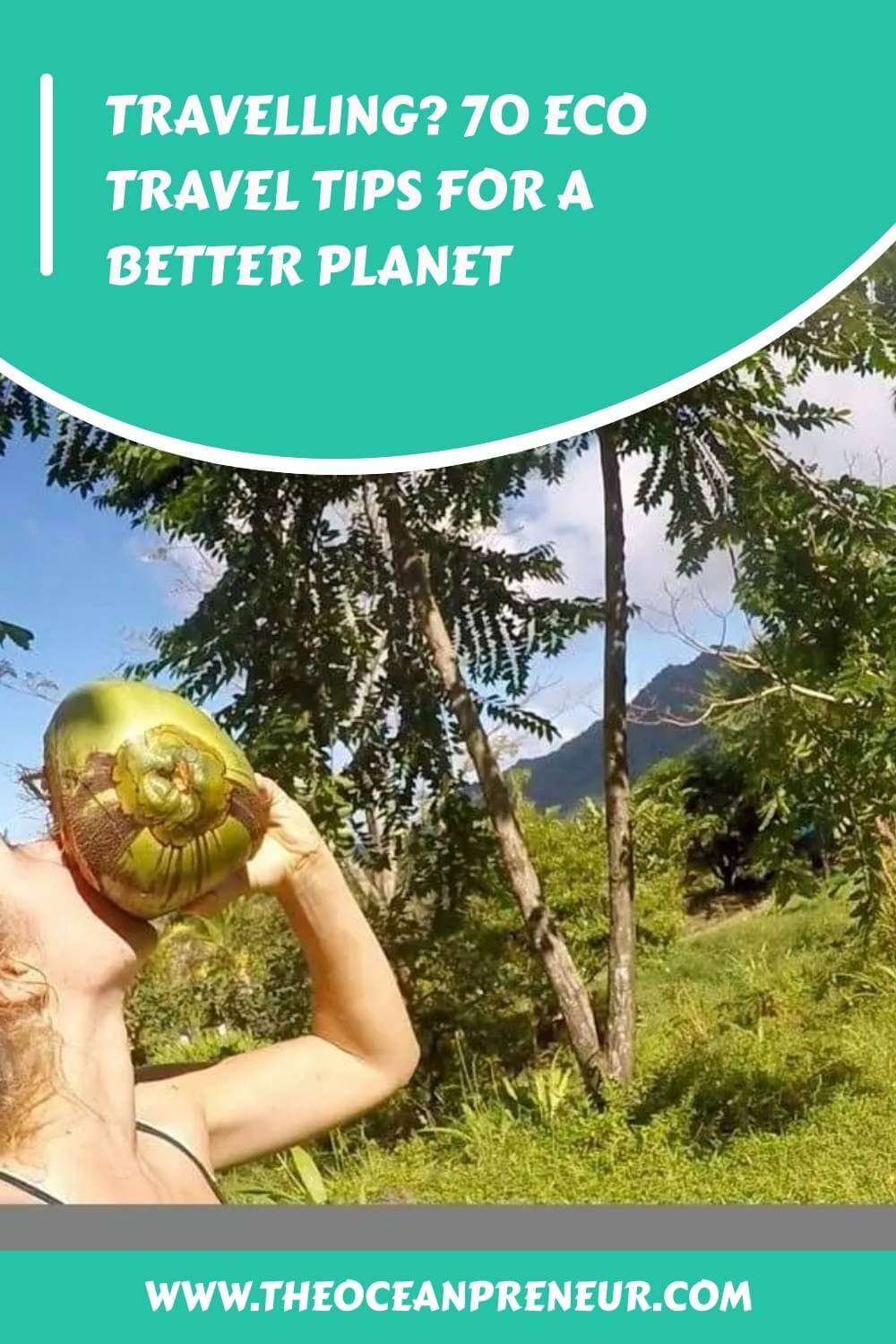
33. Ask where the coconut comes from
In parts of Thailand, 90%+ of coconuts are picked by chained monkeys. Where there's demand, there's supply. Find the guy who gets them straight from the tree for you. It's fresher anyway.
34. Say no proactively
“No straw.” “No bag.” “No napkins, thanks.” “No receipt.” Learn the phrase in the local language. Three weeks of saying no in Asia = roughly 130 plastic items not made. Multiply that by everyone who does it.
Experience
35. Watch wildlife from a distance
Don't touch manta rays. Don't hug koalas. Don't pick up sea stars for a photo. Don't chase turtles. They get stressed. They get sick. They die. Stay 1+ meter away, always. No one's grabbing you while you sleep, right?

36. Skip the unethical tourist experiences
Photo with a tiger. Snake around the neck. Elephant ride. Chained monkey selfie. Lantern release. Tour where the guide pulls the turtle out of its hiding place. None of it. If it makes the animal a prop, walk away, and tell others why.
37. Spread your spending
Don't eat at the hotel every night. Different cafe, different bar, different shop. You discover more, your money goes to more families, and you actually see the place.
Environment
38. Use only what you'd use at home
Just because the shower's “free” doesn't mean it's free for the planet. Tap off when shampooing, brushing teeth. Charger out when you leave. Lights off. Same as home, but on the road we tend to forget.
39. Decline daily room cleaning
Sheets and towels don't need washing every day. Power, water, and harsh detergents drain into local waterways. Hang the “do not disturb” sign and reuse like you do at home.
40. Take 3 for the sea
Every time you walk on a beach, pick up 3 pieces of trash. Take 3 for the Sea. If everyone does it, beaches start clearing themselves. Bonus: join or organise a clean-up. About 14% of the world's coral reefs have been lost since 2009, and a lot of what's killing them is what we leave behind.

41. Skip the single-use toiletry sachets
Those little hotel shampoo packets are the worst. Use the bar you packed. Or refuse them at check-in.
People
42. Connect with the locals
At the homestay. At the market. At the beach. You'll get a far better trip, and they'll get a real conversation with someone from somewhere else. Both sides win. Learn a few words of the local language before you go. Duolingo is enough for the basics.
43. Help where you can
You're a guest. What can you do? I once stopped writing a blog post to help a guesthouse owner set up an Instagram account so his low-season was less brutal. Free lime juice, made a friend, made his day. Small things compound.
44. Be the example
Your bottle. Your “no straw.” Your refusal of the plastic bag. People notice. Especially other travellers. Especially kids.
45. Don't give to begging kids
It keeps them out of school. No candy either, they often don't have a dentist. Make them smile instead. A joke. A drawing. A funny face. A smile goes further than a coin and doesn't trap anyone in the cycle.
Part 3: After You Get Back
46. Calculate and offset your impact
Use the Ocean Foundation calculator or WWF footprint calculator to see what your trip cost the planet. Then offset it: plant trees, adopt a coral, fund a real ocean project. The way I do it now is through Ocean Nomads: every membership funds expeditions, education, and the community of people doing the work on the water.
47. Tell your friends
The local guesthouse you loved. The coral-friendly sunscreen that worked. The reusable bottle that saved you 50 plastics. Tag the small businesses. Use local hashtags. Your social reach has more impact than you think.
48. Write reviews. Good and bad.
Google, TripAdvisor, Booking. Highlight the places doing it right. Call out the ones harming wildlife or chaining monkeys. Reviews change behaviour faster than complaints to nobody.
49. Buy ethical, buy second-hand
Most “fast fashion” travel gear becomes ocean microplastic in 6 months. Buy less, buy better, buy used. Shop Like You Give A Damn for ethical clothing. Project Cece for sustainable fashion. Waschbaer for organic basics. Hemp, bamboo, organic cotton, not synthetics.
50. Try all of this at home too
The most powerful thing about travelling consciously is realising that none of it stops when you fly home. The bottle, the bag, the spork, the plant-forward meals, the no-receipt, that's the actual life. The trip is just where you got to practise.
7 Mistakes Eco Travellers Still Make (Even The Well-Meaning Ones)
I've made all of these. Most people I meet on the road are still making at least three. Worth knowing about.
1. Thinking recycling is enough
It's the last R for a reason. Refuse first, reduce second, reuse third. Most “recycling” in tourist destinations doesn't actually get recycled, it gets shipped, dumped, or burned. The bottle you didn't buy beats the bottle you sorted into the right bin.
2. Booking “eco hotels” without checking
Anyone can call themselves eco. The bamboo wallpaper and the linen-coloured website don't mean a thing. Check for a third-party ecolabel (Green Key, Travelife). If the only “eco” credential is a paragraph about “loving nature” on the homepage, it's marketing.
3. Flying short distances when there's a train or ferry
A 1.5-hour flight in Europe is often replaceable with a 4-hour train and a coffee. Take-off and landing are the worst part of any flight, so short flights are disproportionately bad per km. Check Rome2Rio. Check Ferryhopper. Check the night train.
4. Buying brand-new “sustainable” travel gear for every trip
The most sustainable item is the one you already own. New bamboo this, new organic cotton that, all of it has a footprint. Use what you have. When something dies, then replace it with the better version.
5. Doing animal tourism without realising
“Sanctuary,” “rescue centre,” “rehabilitation”. Sometimes real, often a rebrand. If the animals can be touched, ridden, photographed-with, fed, or perform tricks, it's not rescue. It's exploitation with better marketing. Read recent reviews specifically looking for the word “free.”
6. Confusing “biodegradable” with “ocean-safe”
A “biodegradable” sunscreen can still bleach corals. A “natural” shampoo can still contain palm oil. The label is doing a lot of work. Check the actual ingredients. Zinc oxide, yes. Oxybenzone, octinoxate, no.
7. Being precious about it
The eco traveller who lectures everyone at the breakfast table is the worst kind of eco traveller. Lead by example, not by sermon. Your reusable bottle says more than ten paragraphs ever will.
Want to travel deeper, slower, wilder?
There's a natural progression once you start travelling like this:
- Level 1: Travel better (the 50 tips above)
- Level 2: Travel slower (thru-hike, vanlife, one place for a month)
- Level 3: Travel by sail (no engine most of the time, no emissions, no schedule)
The lowest-impact, most life-changing way I've ever travelled is by sailboat. Months at sea, blue water, real adventure, real community. And you don't need to own a boat, you can crew on someone else's.
Inside Zero to Ocean Nomad I take you from “no experience” to confidently stepping onto a sailboat as crew. We're crossing the Atlantic together winter 2026/2027. Spots are limited. Learn about Zero to Ocean Nomad
Frequently Asked Questions
What is eco-friendly travel?
Eco-friendly travel (also called sustainable travel or responsible travel) means making choices that reduce your environmental impact, respect local communities, and support the places you visit instead of harming them. It covers transport, accommodation, food, packing, and how you behave once you're there.
What is the most eco-friendly way to travel?
By foot, by bike, by sail. Anything human-powered or wind-powered. Within “powered” travel, the order from best to worst is roughly: train, bus, electric car, petrol car, short-haul flight, long-haul flight, cruise ship. Cruise ships are the worst per-passenger-km of any mainstream tourism mode.
What's the single most impactful eco travel change I can make?
Travel slower and travel less by air. One long trip beats four short flights. Within a trip, the next biggest swap is a refillable water bottle with a built-in filter, it eliminates dozens of plastic bottles per trip.
Is sustainable travel expensive?
Usually the opposite. Slow travel is cheaper than fast travel (fewer flights, fewer transfers). Locally owned guesthouses are cheaper than chains. Local markets are cheaper than restaurants. House-sitting and Workaway are free. The single most expensive way to travel is the most polluting one: short flights, all-inclusive resorts, fast itineraries with multiple destinations.
How can I travel sustainably on a budget?
Slow travel one country instead of fast travel five. Use buses and trains. Stay in homestays, hostels, or use platforms like Workaway, WWOOF and TrustedHousesitters where you trade time or pet care for accommodation. Cook your own meals from local markets. Pack a filtered water bottle so you never need to buy bottled water. Avoid fly-in-fly-out short trips, the flight is usually 60-80% of the trip's emissions and a big chunk of the cost.
Is flying always bad?
Flying is the highest-emission travel mode per passenger-km, but “always bad” is too simple. A long-haul flight followed by 6 weeks of slow travel and homestays in one country has a lower per-day footprint than 4 short weekend flights to European cities a year. The real lever isn't “never fly”, it's “fly less, stay longer, and pick the train when it works.” If you do fly, take the most direct route (take-off and landing are the worst part), fly during the day, and pick newer aircraft when you can.
Is reef-safe sunscreen actually different?
Yes. Standard sunscreens contain oxybenzone and octinoxate, which bleach corals and disrupt marine life even at very low concentrations. Reef-safe sunscreens use mineral filters (non-nano zinc oxide) that sit on the skin instead of being absorbed. Hawaii, Palau, Bonaire, Aruba, the US Virgin Islands, Key West, parts of Mexico, and Thailand's marine parks have all banned non-reef-safe sunscreens at entry or in protected areas.
How do I find genuinely eco-friendly accommodation?
Look for third-party ecolabels like Green Key or Travelife, these require independent audits, not just self-claims. Book direct with the accommodation rather than through platforms when possible. Choose smaller, locally-owned places (homestays, family guesthouses) over large chains. Or skip accommodation entirely with house sitting (TrustedHousesitters), Workaway, or Campspace.
How do I find ethical, low-impact tours?
Look for small group sizes, locally-owned operators, ecolabels, and clear sustainability commitments. For multi-day eco-tours and walking holidays, browse TourRadar's eco-tour collection and filter by group size and rating. For day activities at your destination, GetYourGuide lets you compare smaller, locally-run experiences. Always read recent reviews and skip anything involving captive animals.
What goes in a zero-waste travel kit?
The essentials: a filtered water bottle, a reusable spork or utensil set, a folding tote bag, a steel or bamboo straw, solid soap and shampoo bars, a refillable toothbrush (bamboo or miswak), reef-safe sunscreen, and reusable travel containers for snacks and toiletries. My full sustainable travel packing kit goes deeper.
More from the Wildful library
Plastic-free & low-impact living
- The full Plastic-Free Nomad guide
- Full sustainable travel packing kit
- The 7 R's: Rethink, Refuse, Reduce, Reuse, Repair, Repurpose, Recycle
- DIY mineral sunscreen recipe
- Biodegradable shampoo guide
- Eco-friendly travel gift guide
Hiking & thru-hiking
- Fisherman's Trail Portugal, full diary & guide
- GR11: 850 km across the Pyrenees
- Waitukubuli National Trail (Dominica)
- Ultralight thru-hiking gear list
- Osprey Eja 48 backpack review
- Hiking hygiene kit
- AllTrails: my go-to app for finding and downloading trails worldwide
- Gaia GPS: for backcountry navigation and topo maps
- Best hiking apps for thru-hiking: my review
Sleeping for free or low-cost
- 10 best house sitting & pet sitting platforms
- Trusted Housesitters (my pick)
- Campspace, land sharing for wild camping
- Ocean Nomads community, members along coasts and trails often welcome and host each other. Sailors, vanlifers, hikers, all of us. Better than any platform because it's people who actually live this way.
Vanlife & off-grid
Travel by sail
- Zero to Ocean Nomad, the crew course
- How to find a sailboat ride
- Why sail as crew, not on your own boat
- Ocean Nomads community
Watch the journey
- My YouTube channel, trail diaries, sailing crossings, vanlife, plastic-free hacks. Subscribe to follow along.
- Instagram for the everyday moments between videos
Why this all matters
- 7 reasons why the ocean matters
- How we're emptying the ocean, overfishing
- Why plastic is a problem (and what you can do)
- What is climate change?
- Ocean Nomads: the community turning all of this into action
Travelling responsibly isn't a competition. It's a practice. You won't get every tip right every trip. Neither do I. But each choice you make, the bottle, the bag, the no-thanks-to-the-straw, the locally-owned guesthouse, the slower itinerary, adds up to a way of moving through the world that doesn't trash it on the way.
Pick three from this list. Try them on your next trip. Add three more on the trip after that. That's how it changes.
What other tips would you add? What's worked for you? Drop a comment, I read them all. And come find me on YouTube and Instagram for more from the road.

Stay wild.
Some links on this page are affiliate links, if you buy something through them, I may earn a small commission at no extra cost to you. I only recommend products I actually use and trust. Affiliate income keeps this site free, ad-light, and independent. Thank you for the support.











Wow Suz! You are truly amazing. You list seems endless and I loved every suggestion you made.
I have a remark about the cotton. Most cotton is harvest in bad labor surcomstances, using lots of water and painted in chemicals. Make sure you buy sustainable organic cotton if you do.
Hemp, bamboo and eucalyptus are great incredible soft fibers and less water is used to produce your clothing.
I am very very curious about the water bottle with filter! In the Netherlands we are blessed with clean water and I always use my camelbak waterbottle and bamboo reusable zozial coffeecup.
By supporting Suz her project on indigogo you can get the filter bottle too.
Keep on going you are truly an inspiration <3
Hey Lonneke! Thank you so much! You are doing great things. And fantastic input on the cotton! I will adapt this in the list to make sure positive action is taken. Keep going :)
What an absolutely awesome – and awesomely thorough – list! Thanks for all the work which went into it.
Thank you Daniel! Glad you like it:)
Great list Suzanne, thank you so much for the input.
This is fantastic! Thanks so much. As a full time travel family we are really trying to be more eco in our approach and started with plastic free