


Table of Contents
- 1. Sailing the Atlantic on a small sailing yacht
- 2. Crossing on a superyacht (delivery)
- 3. A transatlantic on a charter yacht
- My take after 5 Atlantic crossings
- 4. Sailing the Atlantic on a tall ship
- 5. Sailboat ferry across the Atlantic
- 6. A transatlantic on a cruise ship
- 7. Crossing on a cargo ship (engine or sail)
- What size boat do you need to cross the Atlantic?
- Finding the right boat is the hard part
- Frequently asked questions
- How do you sail across the ocean?
- How do I find a crew position on a sailboat?
- I'm looking for a sailing vessel for my project. Where do I start?
- How do ships cross oceans?
- How do you travel across oceans without flying?
- What's the cheapest way to sail across the Atlantic?
- Can a yacht cross the Atlantic?
- How long does it take to sail across the Atlantic?
- What's the best time of year for a transatlantic crossing?
- Which boat is right for you?
Updated September 2026. You want to cross the Atlantic without flying. The question is: on what kind of boat? It matters a lot for the experience so good you are doing your research.
I've sailed across the Atlantic five times now, on five completely different vessels. Small monohull, big catamaran, tall ship, racing boat, charter yacht. Each one was a different world. Different crew, different daily rhythm, different level of comfort, different price tag, different feeling at the end.
If you're trying to figure out which option is right for you, this article breaks down the 7 main ways people actually cross the Atlantic by sea. The good, the real and the practical. I've experienced most of them.
Quick answer: what size boat, and which kind?
36 ft is the practical minimum and 40 to 44 ft is the sweet spot: about 90% of the boats crossing are over 36 ft, and roughly 70% of crossings are on monohulls. After five crossings my own pick is a 40 to 44 ft monohull with a crew of three or four. The full size guide is further down, and the seven ways across are next.
The 7 ways across, at a glance
- Small sailing yacht (private): adventurous, social, cheap or free, takes effort to find
- Superyacht delivery: faster, more comfortable, tight schedule, less freedom
- Charter yacht: organised, you pay €2,000-€10,000, fixed dates
- Tall ship: spectacular, unique experience, traditional sailing
- Sail boat ferry: doesn't really exist yet, but coming
- Cruise ship: cheap, fast, environmentally awful
- Cargo ship (engine or sail): no-frills, niche, possible

1. Sailing the Atlantic on a small sailing yacht
This is the classic option. Every year, hundreds of privately owned sailing yachts make the transatlantic crossing. Some are heading to the Caribbean for the season. Some are sailing around the world. Some are doing the trip of a lifetime.
The captains are a mixed crowd. Young pirates who escaped the rat race. Adventure couples. Retirees living the dream. Families with kids on board. Solo sailors looking for company. The largest share of captains is between 50 and 65, the group with the time and means to do it. Nationality-wise, the French and Swedish seem to dominate the fleet, but you'll meet everyone.
If you crew on a small yacht, you'll be involved in everything. Watch keeping, sail handling, cooking, navigation, repairs. You'll learn fast. Most boats stop in Cape Verde or the Azores along the way, and they're rarely on a tight schedule.

Monohull or catamaran?
Both monohulls and catamarans cross the Atlantic regularly. Catamarans are generally faster, more spacious, and rock less. The flip side: they can flip. If they do, it's extremely hard to recover. It's also extremely rare.
Having watched hundreds of boats prep and cross, I'd say roughly 70% of transatlantic sailing crossings are on monohulls. They're more affordable, more common, and (in my opinion) more fun to sail. You actually feel the boat. It's the difference between a scooter and a quad bike.
This is the option most Ocean Nomads choose. We did a survey on 131 people sailing across the Atlantic to get their insights. If you want to know exactly how to find the right boat, assess the captain, and get on board safely, skillfull and well prepared, that's what Zero to Ocean Nomad covers. I've put all my best tips and tricks in there from a decade of navigating the big blue.
2. Crossing on a superyacht (delivery)
Many large yachts cross the Atlantic as a delivery. The boat needs to move from point A to B. New charter season starting in the Caribbean. Owner waiting on the other side. New buyer who needs the boat repositioned. It happens constantly.
Usually paid professional crew handle these transatlantic deliveries. As an amateur, you can sometimes get on as a cheap extra set of hands.
A yacht is a “superyacht” when it's over 24 metres (79ft). These are big boats. They run generators daily to keep fridges and freezers going. They carry thousands of litres of fuel and water. They're less dependent on the wind, which means less risk and more comfort.
The trade-offs:
- Tight schedules. Less flexibility for stops in Cape Verde or the Azores.
- More people on board. Often 5-8 instead of 3-5 on a smaller vessel.
- You're expected to work. This is a delivery, not a holiday.
- Less actual sailing. Many superyachts don't even use the sails to avoid wear. Sails get tip-top for when the owner is on board.
- Crew are often younger and have crossed many times before, so they're less excited about it.
It's faster, less adventurous, and more comfortable. Good if you want the crossing experience without the prep grind. Less good if you want the full ocean adventure. My second Atlantic ocean crossing was on a 90 ft superyacht. I loved it! But I loved the small yachts more. More raw and simple.
3. A transatlantic on a charter yacht
If you'd rather skip the pre-crossing search and prep, and money isn't the limiting factor, you can book a charter ocean passage. Atlantic ocean Charter trips run on all sorts of boats: small, big, monohulls, catamarans, even racing boats reaching speeds of 35 knots.
A charter transatlantic trip costs between €2,000 and €10,000. The advantages:
- It's likely to actually leave on the planned date
- Provisioning, cooking, and logistics are usually handled. A lot of it at least.
- Charter operators have to comply with safety standards (though you should still do your homework!) I have come across way to many people who lost 1000s of euro deposits as the boat turned out differently than claimed.
The downsides:
- The fixed schedule cuts both ways. What if the weather window is bad on day one?
- You don't know your shipmates. With private yachts you can meet the crew before committing. On a charter, you're stuck with whoever booked.
- It's expensive. Most adventure-style sailors prefer to spend that money on a year of cruising instead of a single crossing.
Want a vetted, charter-style transatlantic crossing?
With Ocean Nomads we plan Atlantic Ocean crossings on hand-picked vessels, with vetted captains and like-minded crew. Skill-building trips. Real adventure. Without the rookie risks.
The winter 2026/2027 expedition is open for booking now: eight legs on SV Twister between November 2026 and March 2027, from Europe down to Cape Verde, across to the Caribbean and back. You can join for a single leg. See the legs and dates.

My take after 5 Atlantic crossings
Here's my take after doing this 5 times.
“What kind of boat are you joining?” That was the first question everyone asked when I told them I was crossing the Atlantic.
At the time, I knew nothing about boats. I thought, does it matter? I just want to make the passage.
It matters. After crossing on five completely different boats, I now know that the type of boat shapes a huge part of the experience. Not just because of the boat itself, but because of the tasks involved and the people drawn to that kind of vessel.
My personal preference: a smaller monohull sailing yacht around 40-44ft. Basic but adventurous. The captains I've met on these boats are some of the coolest humans I know. The boats are fun to sail. You actually feel the ocean. Smaller boats mean less work, more time exploring port, more time socialising. You go with the weather, not against the schedule.
This is the way I crewed across for years. Here's a video summary of my story.
For my book, Ocean Nomad, I surveyed 100 Atlantic crew and captains. Everyone got the same question: “If you'd do it again, what would you do differently?” The answer that came back over and over again:
“I'd take more time to find the right vessel, with like-minded people who share my values.”
Finding a boat is easy. Finding the right boat, with the right people, is where most crossings get made or broken.
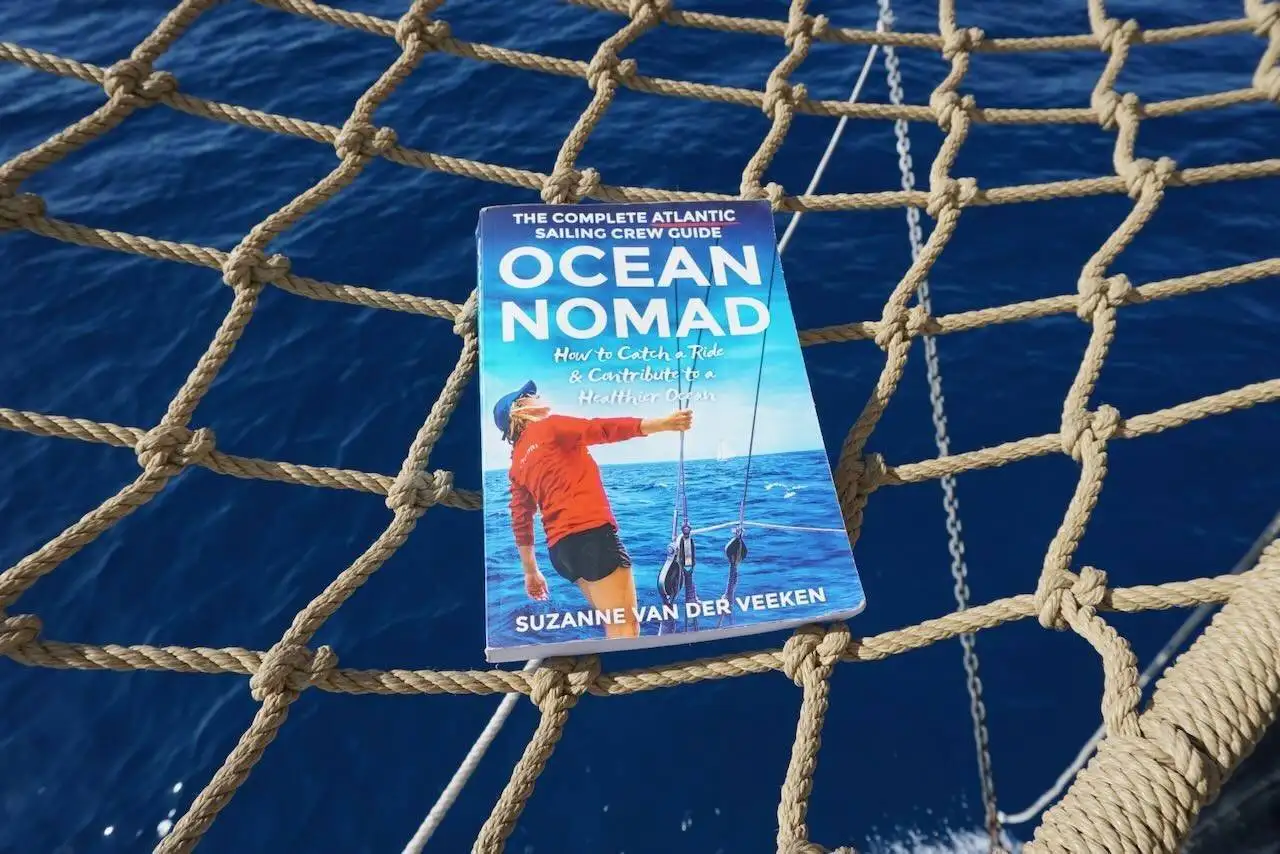
The book: Ocean Nomad, the Atlantic sailing crew guide
Everything I wish I'd had when I hitched my first ride across as a complete newbie: how to find a boat, how to tell a good one from a bad one, and how to be the crew a good captain wants to keep. 400 pages, 32 captains and 58 crew interviewed, over 4,000 copies sold.
Get the bookNow back to the rest of the options.
4. Sailing the Atlantic on a tall ship
Every year, classic tall ships cross the Atlantic. Stad Amsterdam, Oosterschelde, and many smaller traditional boats. With Ocean Nomads we sailed across with SV Twister, a beautiful traditional vessel.
Sailing across on a tall ship is something else. The rhythm is different. The community is different. You climb the rigging. You pull lines as a team. You get the feeling of how humans have crossed oceans for centuries.
You can either work as crew (some young people do this for free passage) or buy yourself a passage as a paying voyage crew member. The latter is the more common route for someone wanting the experience.

In 2022/2023 I organised a trip with Ocean Nomads across the Atlantic, the Caribbean, and back across the Atlantic on the SV Twister. It was my 5th transatlantic crossing. We made a film about it:
Sail the Atlantic on SV Twister this winter
Twister sails again, and this time you can be on board. Eight legs between November 2026 and March 2027: from Europe down to Cape Verde, across to the Caribbean, island hopping, and back. The crossing itself leaves Cape Verde on 3 January 2027. You don't need to own a boat, and you don't need to do the whole route. Pick a leg.
See the legs and dates5. Sailboat ferry across the Atlantic
Short answer: this doesn't really exist yet. There are no scheduled sailing ferries crossing the Atlantic.
That said, boats are being built and projects are emerging. With Ocean Nomads we're working on tools, systems, and connections to help people travel from A to B by sail. The infrastructure is slowly being built.
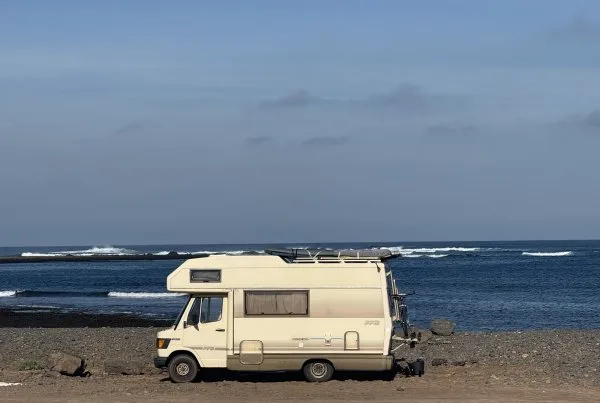
If you just want to skip a flight to the Canaries, there's already a ferry from mainland Spain to the Canaries. I'm writing this from my van in Tenerife after taking exactly that route.
6. A transatlantic on a cruise ship
More cruise ships cross the Atlantic than you'd think. Many of them move seasonally between Europe and the Caribbean, and the spots get sold as “repositioning cruises.” It's often cheaper than a flight plus a month's rent combined.
It takes around eight days. You'll have entertainment, restaurants, internet, a cabin, and zero connection to the actual ocean.
Cruise ships are not a kind way to cross. Data on emissions is harder to find than it should be, but here's what's documented:
- An average cruise ship at sea is reported to emit more (and less filtered) smoke than one million cars combined per day.
- In a one-week trip, a large cruise ship generates around 10 backyard swimming pools of blackwater (raw sewage) and 40 swimming pools of greywater.
- It also generates oily bilge water, sewage sludge, garbage, and a lot of underwater noise that disrupts marine life.
It's an option. It's just not one I personally recommend if you care about the ocean you're crossing.
7. Crossing on a cargo ship (engine or sail)
More cargo ships cross the Atlantic than sailboats. They sometimes rent out a few cabins to passengers. It costs a few thousand euros, takes one to two weeks, and runs at 15-25 knots depending on weather and load.
If you don't enjoy sailing but don't want to fly, a cargo ship can work. Just be ready for engine noise everywhere, all the time.
There's also a small but growing world of sailing cargo ships:
- Tres Hombres is a 32m schooner moving traditional goods like rum and chocolate between the Caribbean and Europe.
- Timbercoast is a 1920-built 43.5m schooner transporting goods like coffee and gin.
Both ships welcome crew on board. It's a beautiful way to combine ocean travel with supporting sustainable trade.

What size boat do you need to cross the Atlantic?
Short answer: 36ft minimum, 40-44ft is the sweet spot.
About 90% of the boats crossing are over 36ft. Most are around 44ft (14m). Big enough to carry the food, water, and fuel needed for 2-4 weeks at sea. Big enough to handle ocean swell and Atlantic storms. Small enough to be sailed by a crew of 2-4 without burning out.
Hulls come in all materials: steel, wood, aluminium, and these days mostly fibreglass. The most common transatlantic crossing boat is a fibreglass monohull around 40-44ft, built in the 1990s or 2000s.
Can smaller boats cross the Atlantic?
Absolutely. We've had Ocean Nomads members sail across the Atlantic on 28ft boats. Six of the 100 sailors I interviewed for my book had crossed on boats under 36ft. All of them said they'd do it again.
People row across the Atlantic. In 2017 someone Stand Up Paddled across. With Ocean Nomads we're even being the support crew for someone kitesurfing across the Atlantic. So size really isn't the limit, prep and skill are.
That said, smaller boats mean less storage, less comfort, more motion, and fewer captains willing to take on inexperienced crew. If you're hitching as crew on a 28ft boat, the captain is usually a friend or someone who knows you well.
Curious about the smaller-boat stories?
Read them and connect with the sailors themselves inside the Ocean Nomads community. Real boats, real captains, real stories of crossings on every size of vessel.
What size for your first transatlantic crossing as crew?
For most people thinking about their first transatlantic crossing as crew, look in the 38-46ft range. That's where boats are seaworthy enough for the open ocean, comfortable enough for a 2-4 week passage, and where you'll find the most captains looking for crew.
Below 36ft, opportunities thin out fast. Above 50ft, you're often looking at superyacht territory with paid professional crew, not the backpacker-style adventure most people are after.
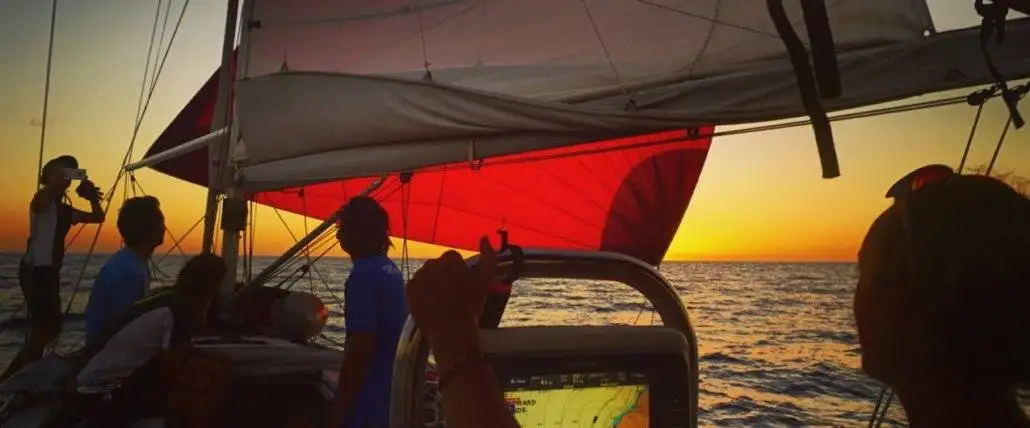
Finding the right boat is the hard part
Most people who reach out to me are stuck in the same place. They've watched the videos. They've read the forums. They know it's possible. They just don't know which boats are safe to step on, which captains to trust, and how to spot the difference before they're already at sea.
That's the right question to ask. After 50,000+ nautical miles on 100+ boats and 5 Atlantic crossings, I've seen what happens when people skip this part. Wrong boat, wrong captain, wrong dynamic at sea, and suddenly you're hundreds of miles offshore wishing you'd asked more questions in the marina. If you'd like some guidance join me and Ocean Nomads in the Zero to Ocean Nomad online mentorSHIP.
The rest of what I use for life at sea and on the road is on my travel resources page.
Frequently asked questions
How do you sail across the ocean?
The basic process: find a seaworthy boat heading the right direction, prep the boat and crew for 2-4 weeks at sea, wait for a good weather window, follow the trade winds. Most Atlantic crossings (east-to-west) leave from the Canary Islands in November and arrive in the Caribbean 18-25 days later. Crews of 2-4 people share watches in shifts of 3-4 hours, day and night.
How do I find a crew position on a sailboat?
The three main ways are online crewing platforms, dockwalking in marinas, and personal networks. Each has trade-offs. Online platforms have volume but quality varies. Dockwalking works in the right ports at the right time of year. Personal networks are where the best opportunities live, most of which never get advertised. The Zero to Ocean Nomad course covers all three methods plus how to write a crew profile captains actually respond to, and above all be safe!
I'm looking for a sailing vessel for my project. Where do I start?
Kitesurfers crossing oceans. Marine biologists doing research at sea. Filmmakers chasing a story. Athletes setting records. Founders testing ideas. Every year people come to me and ocean nomads looking for the right vessel for their project, not just a passage. The match between project, vessel, and captain matters even more here than for regular crewing.
The best place to find your support is inside the Ocean Nomads community. It's why we set it all up! To help you make your ocean mission real. Boat owners post their plans, project people share what they're working on, and connections happen. Like Koen the kitesurfer who found his vessel through the network. It's where like-minded people, vessels, and ideas meet.
How do ships cross oceans?
Modern ocean-crossing vessels follow established routes that take advantage of trade winds, currents, and avoid known storm zones. Sailing yachts use the trade wind routes (down to the Canaries, across to the Caribbean). Powered ships pick the most direct course depending on weather and fuel range. Cargo ships and cruise ships use sophisticated weather routing software to optimise their journey.
How do you travel across oceans without flying?
Five real options exist: crew on a private sailboat (cheapest, most adventurous), book a charter passage (€2,000-€10,000), buy passage on a tall ship, take a cruise ship “repositioning cruise,” or take a cabin on a cargo ship (a few thousand euros). Sailing yacht crewing is the most accessible if you have time and flexibility. See the 7 options earlier in this post for the full breakdown.
What's the cheapest way to sail across the Atlantic?
Crewing on a private sailboat. Costs typically €0-50/day, sometimes free in exchange for work on board. You contribute to food and provisions, the captain provides the boat. Far cheaper than a charter (€2,000-€10,000) or a transatlantic cruise.
Can a yacht cross the Atlantic?
Yes. Hundreds of yachts cross every year. Both monohulls and catamarans. Most are 36ft or larger, but smaller yachts cross too. The boat needs to be seaworthy, properly prepared for ocean conditions, and crewed by people who know what they're doing.
How long does it take to sail across the Atlantic?
East-to-west (Canary Islands to the Caribbean) takes 18-25 days for most cruising sailboats. West-to-east (Caribbean or US to Europe via the Azores) takes 25-35 days, often longer due to less predictable weather. Tall ships and slower boats can take 30+ days. Racing yachts can cross in under 10 days.
What's the best time of year for a transatlantic crossing?
For east-to-west: November through January, after hurricane season ends. The ARC rally and most private yachts leave the Canaries in November. For west-to-east: May or June, before hurricane season starts in the Atlantic.
Land ahoy after my 4th (and most rough!) Atlantic crossing.

Which boat is right for you?
The right boat to cross the Atlantic on is the one that fits you: your time, your budget, your appetite for adventure, and what you want to take from the experience.
If you have time and want the real adventure, find a small private yacht and go (Zero to Ocean Nomad is created to help you create your own wild blue adventure). If you have money and want it organised, book a charter or join an Ocean Nomads trip. If you want something traditional and special, find a tall ship. This winter you can do that with us: SV Twister sails the Atlantic in eight legs, November 2026 to March 2027. If you don't like sailing but want to skip the flight, look at cargo ships.
Whatever you pick, take the prep seriously. Don't give up. And enjoy the ride. Before you know it, you're on the other side.
If you want the full playbook for finding the right boat, assessing captains and getting on board safely, start with my book, Ocean Nomad: the Atlantic sailing crew guide. 400 pages, over 4,000 copies sold, and the whole story of how I hitched my first ride. If you'd like guidance along the way, Zero to Ocean Nomad is where I put everything I learned across those 5 crossings.
Hope to see you on, in, and near the sea.
Suzanne
PS. If any of this has helped you, I'd love to hear about it. Drop a comment, leave a review on or fill out the big Atlantic Ocean Crew Survey.
Sail the Atlantic with us
This winter we're sailing SV Twister on a full Atlantic circle: Amsterdam to the Caribbean and back, in eight legs. Beginners are welcome on most of them, including the Tenerife to Cape Verde crossing over Christmas (18 to 29 December).
See the Twister 2026-27 expedition and pick your leg
Ocean Nomads members get a discount on every leg, plus many more goodies. Join the tribe.
You may like reading: the boat-hitchhikers of Las Palmas marina.
Everything I know about catching a ride across the Atlantic as crew is in my book, Ocean Nomad. 400 pages, from finding a boat to landing on the other side.
Get the bookRelated Posts

















The best appropriate boat is about 30 to 40 feet long. In case you using a smaller boat, there is a possibility that it may not withstand harsh weather conditions and ocean currents.
thank you so much for this cool article.
This post was super informative! I’m really interested in sailing across the Atlantic one day, and your breakdown of the different types of boats is incredibly helpful. I never realized how much the choice of vessel could affect the experience. Thanks for sharing your insights!