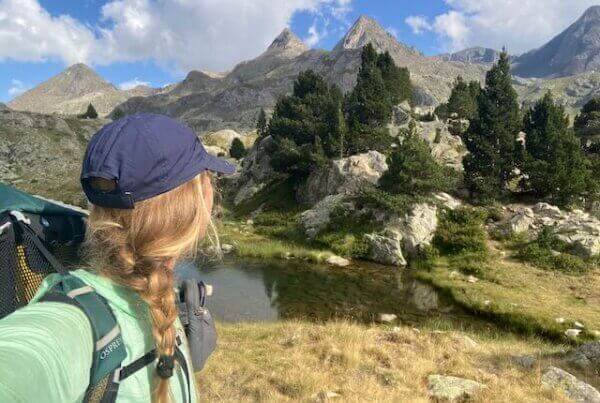

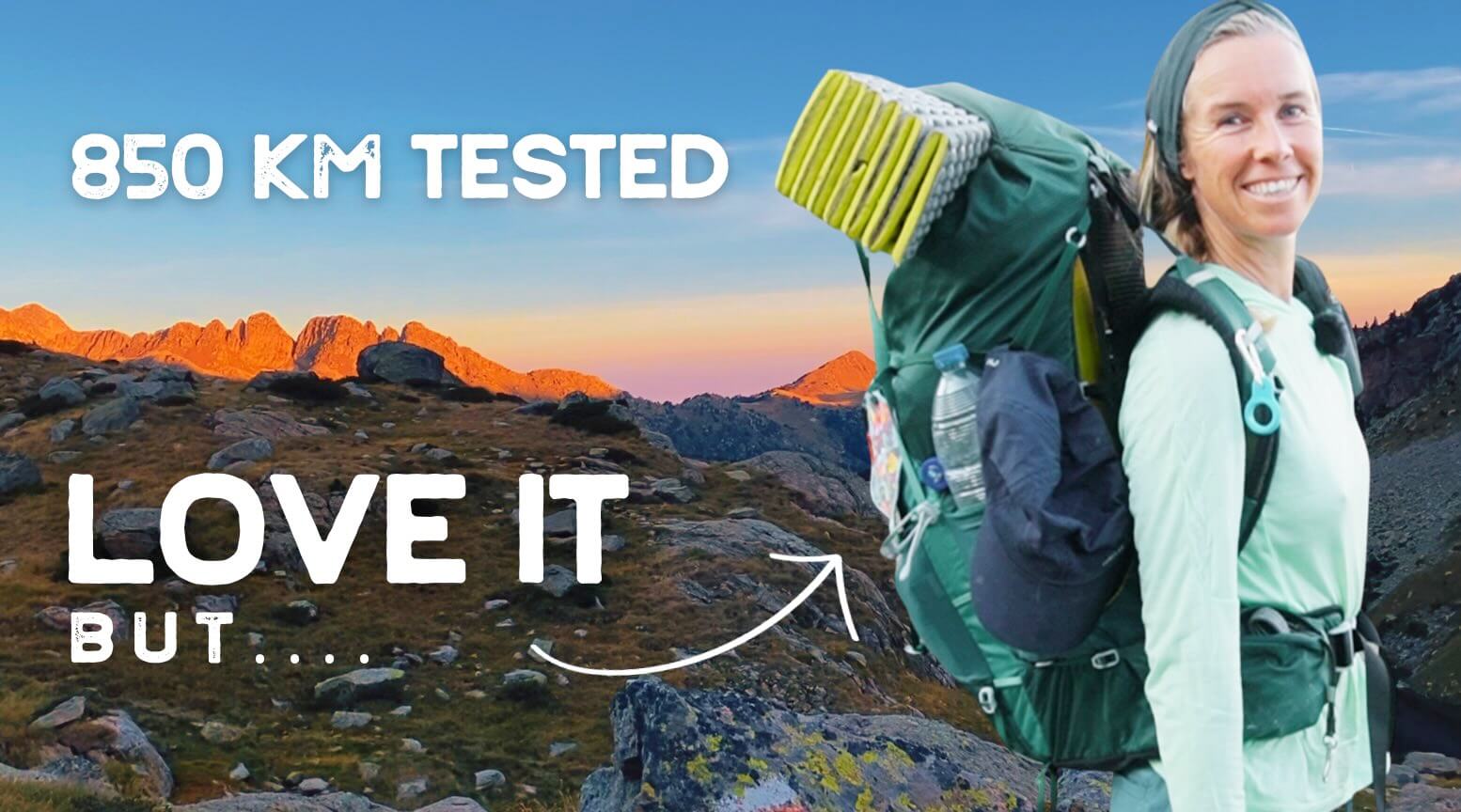
Hey wild one. I hiked 850 km across the Pyrenees on the GR11 with the Osprey Eja 48 on my back. Solo, with my dog Wingo, summer 2024, Atlantic to Mediterranean. The backpack carried me, all my gear, food for both of us, and water up and over 2500 m passes for 50 days straight. I'd take it again tomorrow. Here's my honest review.
From experience comes awareness. From caring comes action.
Short answer: yes, worth it.
The Osprey Eja 48 is the best all-round ultralight-ish backpack I've tested for women doing long distance hikes. Framed, ventilated, comfortable with loads up to 12 kg, made from recycled nylon, PFC-free. At 1.2 kg it's heavier than full ultralight frameless packs, but the back comfort and hip support are worth the extra grams if you're hiking multiple weeks or need to carry food and water for resupplies.
Watch the Video Review
Why I Chose the Osprey Eja 48
Backpacks are like shoes. You only really know if they fit once you've walked with them. So I didn't want to base my choice on reviews alone. I wanted a pack that could carry the load of a self-supported thru-hike with a dog, handle multiple weeks of abuse, and still feel good on my back at the end of a 25 km day at altitude.
At around 1.2 kg with the lid (Osprey calls it the FlapJacket), the Eja 48 is light for a framed pack. I ditched the lid to save another 120 g and to stop myself cramming unnecessary stuff in there. Less space, less temptation.
I considered lighter frameless packs, but for me the comfort and hip support of a framed backpack mattered more, especially carrying extra food, water, and dog supplies. My partner Jonatan used the men's equivalent (the Exos) on the PCT and the Appalachian Trail and kept raving about it. That was my final push.
Osprey Eja vs Eja Pro vs Exos: Quick Comparison
Before we go deeper, here's how the Osprey Eja series compares. The men's version is called Exos and the women's is Eja. Same design, different fit.
For most women doing a long distance trail with normal (not super minimalist) gear, the Eja 48 is the best middle ground. If you're going winter or carrying climbing gear, the 58 makes sense. If you're already ultralight and want to shave 200 grams, the Eja Pro 55 is worth looking at, but the fabric is thinner and less durable.
Comfort and Fit: The Feature That Saved My Back
This is the best part of the Eja. The back panel has proper ventilation (Osprey calls it AirSpeed), which keeps the pack slightly off your back. It's one of those features you don't appreciate in the shop, but on day 17, sweating up a mountain pass in 30°C sun, you'll be grateful.
The hip belt is sturdy and padded. The hip belt pockets are great for trail snacks but too small for a modern phone. I use a separate shoulder strap pocket for my phone and love it.
The shoulder straps and adjustable torso length let me fine-tune the fit. I was between sizes (S/M and M/L) and went for the larger one, which was right when I was wearing a jacket. During the hike I lost some weight, so in hindsight the S/M might have been better. But I'd rather have too much adjustment room than too little.
Across 850 km with loads up to 11 kg (food + dog food + 2L water), I never had back pain. That's rare on a long thru-hike. My base weight is between 6 and 7 kg. Here's my full packing list for long distance hikes.

Storage and Accessibility
The Osprey Eja 48 has everything you need for a multi-week thru-hike:
- Two hip belt pockets for snacks, lip balm, headphones
- Mesh side pockets that you can reach without taking the pack off
- A big stretchy front mesh pocket. I used mine for my water filter, spoon, and trash
- A hydration sleeve inside the main compartment (I never used it, I prefer bottles)
- Plenty of compression straps to cinch the pack down or strap on a sleeping bag, poles, or tent
It's a lightweight pack but still versatile. Thanks to the frame and suspension, you don't need to pack it perfectly to make it carry well. I love that, because I'm a little chaotic.
Here's a short video of me unpacking the Eja 48 at camp in the Pyrenees: Setting up camp on the GR11.
Sustainability: Recycled Nylon, PFC-Free
Another reason I chose the Eja is that Osprey has made it with recycled nylon and it's PFC-free.
PFCs (perfluorinated compounds) are those “forever chemicals” used to waterproof gear. They don't break down in nature and they've been found in wildlife, drinking water, and human blood. So I like knowing my pack isn't leaving a toxic trace on the places I hike. Just my footprints, and sometimes paw prints.
Planning your first thru-hike?
The right backpack is one piece of the puzzle. Figuring out the rest (what to pack, what to skip, how to prepare) is where most people get stuck. I made a free Starter Map with the steps Jonatan and I take before every trail.
Downsides of the Osprey Eja 48
No backpack is perfect. Here's what I'd change:
- Hip belt pockets are too small for a phone. Easily solved with a shoulder strap pocket.
- Lots of straps and adjustment points. Can feel fussy until you get the fit dialled in.
- The tall suspension blocks wide hats. My favourite adventure hat knocks into the frame. Adventure problems.
- Heavier than fully frameless packs. If you're already base-weight 4 kg and willing to take the risk of less durability, the Eja Pro 55 or a frameless cottage-brand pack will save you weight.
Here I am wearing my favourite adventure hat on the Waitukubuli National Trail, a jungle thru-hike across Dominica where Jonatan and I were the first thru-hikers in 5 years.

Framed vs Frameless Ultralight Packs: Honest Take
The Osprey Eja 48 is a framed pack, which means more comfort with weight but slightly heavier than frameless ultralight options.
Framed pros: better load transfer to hips, more comfort with heavy loads, better ventilation through the back panel.
Framed cons: a little heavier, bulkier, the tall frame gets in the way of wide hats.
Frameless pros: super light, minimalist, packs down smaller when not full.
Frameless cons: less support, trickier to pack, not ideal for heavy food resupplies.
I haven't owned a frameless pack so I can't speak from personal experience. But I met many hikers on the GR11 who were carrying frameless ultralight packs and complaining about back pain, especially during heavy resupplies where they had to carry 5-6 days of food through remote sections. Saving 300 grams isn't worth it if you hurt for a week. For first thru-hikes especially, I'd go framed.

Is the Osprey Eja 48 Worth It? My Verdict
Yes. After 850 km from the Atlantic to the Mediterranean across the Pyrenees, carrying everything I needed for myself and my dog, including food for a week at a time and 2L of water on dry days, the Osprey Eja 48 held up. Comfortable, durable, well ventilated, ethically made. It's not the lightest pack on the market but it's the best balance of weight, comfort, and durability I've found for women doing long distance trails.
If you want more space or less weight, the Eja Pro 55 is the next one to look at. If you want the men's version, it's the Osprey Exos.
One More Reason I Trust Osprey: The Lifetime Warranty
Osprey's All Mighty Guarantee is a lifetime warranty on every pack they've ever made. If your pack breaks (zipper, buckle, frame, strap, anything), you send it in, and they either repair it or replace it with a new one. No receipt needed.
This isn't marketing fluff. Jonatan just got a full replacement pack after years of hiking with his Osprey Exos. He's put over 10,000 miles on that thing: the PCT, the Appalachian Trail, the GR11, the Fisherman's Trail, and plenty more. The pack eventually wore out, he sent it in, and Osprey sent him a new one.
For a piece of gear this important, knowing it's covered for life changes the math. Spending a bit more on a pack that'll last you decades, or get replaced free when it doesn't, is far more sustainable and honest than buying a cheaper pack that lands in landfill after two seasons.
Ready to get yours?
Links below will help you find it in your local store, online retailers, or second hand.
Frequently Asked Questions
Is the Osprey Eja 48 good for thru-hiking?
Yes. I used it for 850 km on the GR11 across the Pyrenees solo with my dog. Comfortable with loads up to 11 kg, well ventilated, good hip support, durable enough for 50 days of constant use. It's my top pick for women doing multi-week thru-hikes.
What's the difference between the Osprey Eja and Exos?
The Eja is the women's fit, the Exos is the men's. Same frame, same suspension, same materials. The Eja has a shorter torso range and a hip belt shaped for women. If you're a woman, go Eja. If you're a man, go Exos.
Eja 48 vs Eja Pro 55: which should I buy?
Go with the Eja 48 if you want durability, comfort, and a pack that handles anything you throw at it, including heavy food resupplies and winter gear. Go with the Eja Pro 55 if you're an experienced ultralight hiker, have a base weight under 5 kg, and want to save 200 grams. The Pro has thinner fabric so it's less durable.
Is 48 litres enough for a thru-hike?
For most multi-week thru-hikes in summer or three-season conditions, yes. I fit a tent, sleeping bag, sleeping pad, cooking kit, food for 5-6 days, 2L of water, clothes, electronics, and dog supplies in the Eja 48 with the lid off. If you're going winter or carrying specialist gear (climbing, skiing), look at the Eja 58 or a bigger pack.
How much weight can the Osprey Eja 48 carry comfortably?
Osprey rates it for up to about 15 kg. My personal range was 7-11 kg loaded. Above 12 kg the pack still carries fine but it's harder work on long climbs. Below 7 kg the frame is almost overkill but the comfort is still worth it.
Is the Osprey Eja waterproof?
No. Like most ultralight packs, the Eja is water-resistant but not waterproof. Osprey includes a rain cover (or you can buy one separately). I also use dry bags inside the pack for critical items like sleeping bag and electronics.
How durable is the Osprey Eja 48?
After 850 km on the GR11 including scrambling, bushwhacking, and rough granite terrain, mine is still in good shape. Some wear on the bottom and a small tear on the front mesh pocket from sharp rocks. No broken buckles, no frame issues, no zipper failures. And if something does go wrong, Osprey's lifetime All Mighty Guarantee has you covered. See the section above.
Does Osprey really repair or replace old packs?
Yes. Osprey's All Mighty Guarantee is a lifetime warranty, no receipt required. You send your pack in, they fix it if it's fixable, or send you a new one if it's not. Jonatan just got a full replacement for his Osprey Exos after 10,000+ miles of hiking on the PCT, AT, GR11, Fisherman's Trail, and more.
What size Osprey Eja should I get?
Osprey makes the Eja in XS/S and M/L. Go by torso length, not height. Measure from the base of your neck (C7 vertebra) to the top of your hip bone. If you're between sizes, I'd lean bigger, because you can tighten a pack that's slightly long but you can't stretch one that's too short. I'm 1.70 m and went with M/L.
What app should I use for thru-hiking with this pack?
My current setup is AllTrails Plus as primary, Mapy.com as free backup, and a Garmin InReach Mini for safety. I wrote a full breakdown of the best hiking apps for thru-hiking here.
Related Reading
If you found this review useful, you might enjoy these too.
More thru-hiking gear and apps
- Best Hiking Apps for Thru-Hiking (2026), what I use on trail and why
- My Full GR11 Packing List, every item I carried for 850 km
- Gift Ideas for Hikers, practical gift guide
- Trail Hygiene: Staying Cleanish on Long Hikes
- Mountain Warehouse Review: Budget Outdoor Gear
Trail guides and long distance hiking stories
- Hiking the GR11: 850 km Across the Pyrenees
- How I Prepared for a Solo Thru-Hike with My Dog
- Fisherman's Trail Portugal: 226 km Coastal Thru-Hike
- GR131 Gran Canaria Trail Guide
- Waitukubuli National Trail, Dominica, first thru-hikers in 5 years
Sustainable adventure
- Zero Waste Travel Kit
- Portable Water Filtration on Trail
- DIY Mineral Sunscreen Recipe
- Foraging for Food on Trail
Keep It Wildful
A backpack touches your body every day of a thru-hike. The right one you forget about. The wrong one ruins the trip. The Osprey Eja 48 is the one I'll keep using for the next trail.
Watch the full video review here on YouTube.
This post contains affiliate links. I only recommend gear I've used and genuinely believe in. When you buy through these links at no extra cost to you, it supports my work creating honest content. Thank you.
Related Posts