

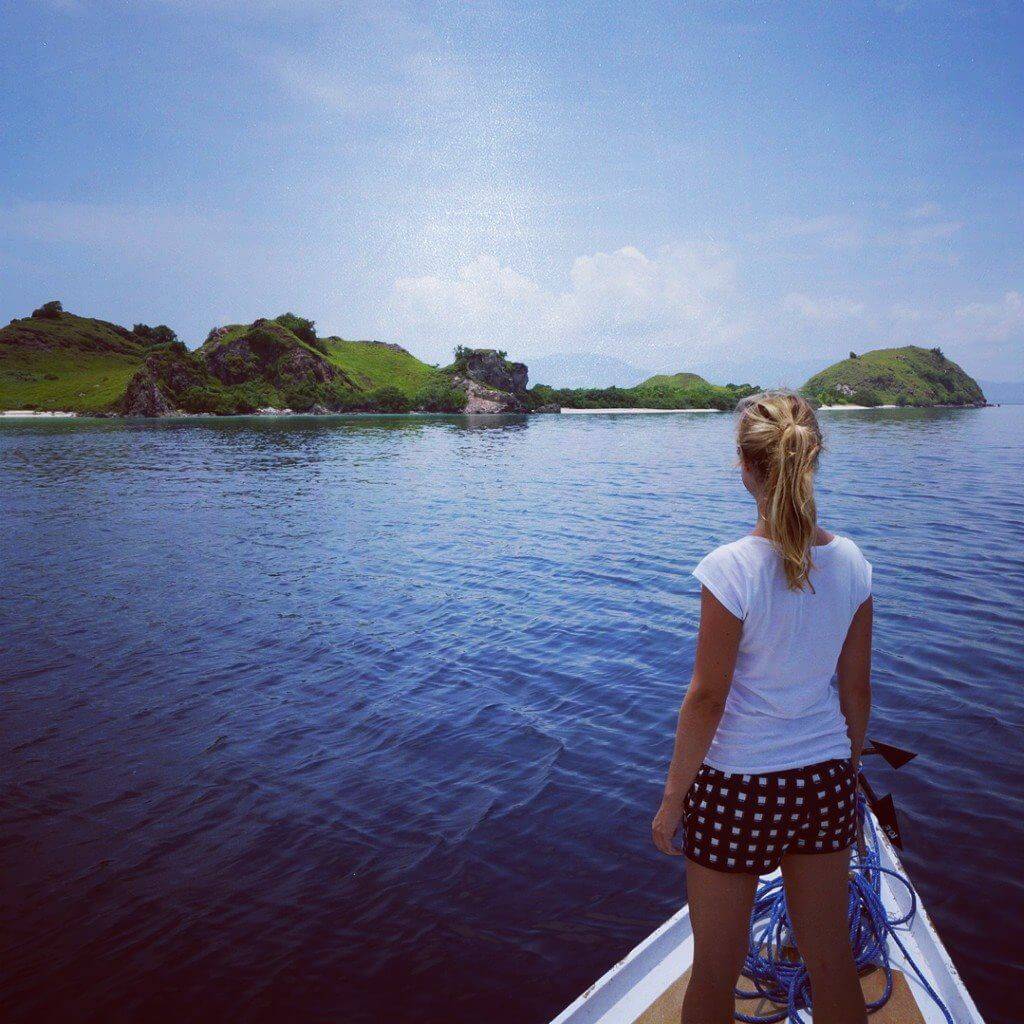
I'm sitting in a blue beanbag on the back deck of a wooden boat called Salacia. Fresh Florenese kopi in hand. Chilled-out music drifting from somewhere behind me. We're cruising through the calm green archipelago at the edge of Komodo National Park, on the way to a beach where I'll sleep in a tent that night.
That was 2014.
Things have shifted since. Camping on the islands inside the national park is no longer allowed (the protected boundary). But you can still sleep on the water on a liveaboard, you can still base yourself in Labuan Bajo, and you can still overnight on islands just outside the park like Kanawa, Seraya and Bidadari, where the small eco-resorts have been running for years. The underwater world is the same wild thing it was in 2014.
Here's how the trip went, and what your version can look like now.
The 2014 trip: two days on the Salacia
So back to that boat.
While I'm in the beanbag, the Salacia (Queen of the Sea) sets off for what will turn into two of the best days of that whole year of travelling. About an hour out of Labuan Bajo we're already in scenery that doesn't look real. Calm water, mystic green islands, no other boats in sight. I keep pinching myself.
Crew leader Max gives us the briefing. Where we're going, what to expect, how we're not leaving anything on the islands except footprints. He's serious about it. Komodo is one of the most pristine pieces of nature I've ever been close to and he wants to keep it that way.
The crew is properly international. A Spaniard living in Norway, a Swiss living in Bali, a Sumatran living in Bali, an Italian living in Flores, three local Florenese guys, and this Dutch person. The kind of mix where everyone's already lived three lives.
A bit of context on the park itself, since this matters.
Komodo National Park sits in West Flores, in the Lesser Sunda Islands of Indonesia. It's a UNESCO World Heritage site (since 1991), one of the New7Wonders of Nature, and right in the heart of the Coral Triangle, the most diverse marine habitat on earth. Three larger islands (Rinca, Komodo and Padar) plus around a hundred smaller ones, all volcanic. About 4,000 people live in the park, more kids than adults. About 5,000 Komodo dragons. Over 1,000 species of fish.
In the week of my trip in February 2014, Komodo also became part of the world's largest manta ray sanctuary. Good timing.
Komodo dragons at Rinca Island
Our first stop is Rinca, one of the four islands where you'll find the dragons.
Reno, the park ranger, makes sure we don't get eaten. His snake-painted stick is, apparently, our weapon for survival. I would not bet on it. The year before, in February 2013, someone disappeared on this island. Reno mentions it in passing, the way you'd mention rain.
He double-checks if any of the women in the group are on their period. The dragons can smell blood from kilometres away and it switches them on. There's a polite pause while we all confirm we are not, in fact, walking lunch.
We take the medium trail, Loh Buaya to Panorama Hill, about 1.5 hours.
The dragons:
- Up to 3 metres long
- 136 kg
- They can run 19 km/hour for short bursts (faster than you)
- Rinca holds between 3,000 and 5,000 of them
At the entrance we see both mature and baby dragons. They're massive. The babies live in trees for the first few years so the adults don't eat them, which gives you a sense of family dynamics here. From Panorama Hill we look out over water buffalos in the distance, eagles riding thermals above us, and a park so big that none of it fits in one view.
We walk back. Nobody is eaten.
Setting sail for Mawan Island

Back on the Salacia, in the far distance I see white lines so bright they hurt my eyes. The beaches of Mawan Island, where we'll camp.
It's rainy season, it's February, it's low season, and there's not another boat in sight. Just hills to climb, turquoise water to explore, and the kind of quiet that makes you realise how loud most of your normal life is.
Halfway across, dolphins start breaking the surface alongside the boat. The closer we get, the clearer the water becomes. From above the deck I can already see corals, fish, and a manta gliding past. A literal manta. Just there. Casual.
After saying “wow” ten times I jump in.
Snorkelling with manta rays

I clear my mask. Open my eyes.
A manta ray. Bigger than me. My heart stops for a few seconds.
She doesn't leave. She stays to swim and dance around me. And then there are more. And more. And more. In the front garden of a deserted island in the middle of Komodo National Park.
Probably the most amazing experience of my life. So far.
Camping on the beach

Once we're back on the beach I spoon out a coconut and hike the trail to the back garden of the island. Through bushes, onto another empty stretch of sand. About a hundred metres offshore some local guys are fishing from their jukung (the traditional outrigger). I'm sure they didn't expect a pink-dressed Dutch person with a snorkel to appear on this side. I swim out to say Selamat siang, and we figure out the afternoon together.
It starts raining a bit. The current gets stronger. It doesn't matter. I'm wet anyway and the rain just makes it weirder and better. The current carries me far from where I got in, so rather than swim back I drift. Slow, all the way around the island, past mangrove roots, two reef sharks moving like smoke, and walls of red coral.
That evening we hike to the top of one of the two hills with a Bintang each. We watch the rain nurturing the green hills below. We grill snapper on the beach. Laughs, drinks, snacks under a small party tent. Early night. With the drizzle on the canvas of the tent, I fall into deep, content sleep.
Mawan is inside the national park, so this exact night, on this exact beach, is no longer on the table for visitors. The blanket no-overnight rule kicked in to protect the wildlife and the islands from the wear of overnight camps. Plenty of operators were doing it well, like the one we went with. Plenty of others weren't. The replacement is the liveaboard for inside the park, or the small eco-resorts on islands just outside the boundary. More on both further down.
Day two: morning on Mawan Island
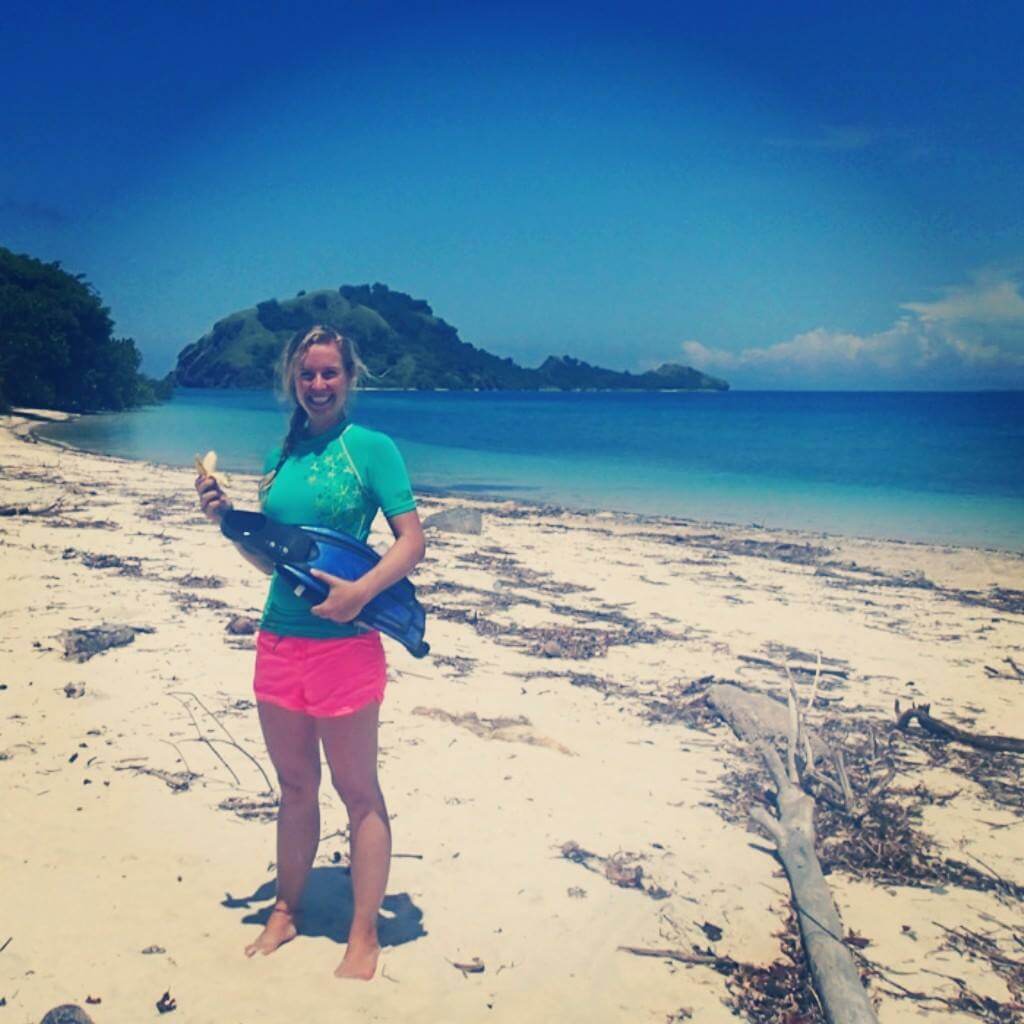
Selamat pagi, Komodo.
I listen to the water coming ashore. Try to identify the insect and bird sounds and fail. The fauna here is unique to Flores. I climb the second hill before breakfast, just to see what the views are like from up there. The grass reaches my hips. Nobody has been up here in a while.
From the top, the park stretches in every direction. Blue, green, blue, green, blue. I could sit and watch it all day.
Breakfast on the beach, then we swim back to the Salacia. High tide. Off to the next playground: Batu Bolong.
Diving at Batu Bolong
Batu Bolong is a tiny rocky islet between two strong currents. We gear up. We descend along the wall.
I don't know where to look.
Hundreds of thousands of fish, fighting for a space to nibble at the coral. Every centimetre is covered with life. The currents here keep food flowing constantly, which is what makes Komodo's reefs the underwater colour disco that they are. Zig-zagging down to avoid the worst of the current at the end of the wall.
Visibility 20 metres plus. Water at 27°C. Perfect.
And it's not only the small stuff. Giant Napoleon wrasse, blacktip reef shark, a sea turtle, parrotfish, triggerfish, barracudas. I've dived the Great Barrier Reef and the Red Sea. Batu Bolong goes straight to number one.
Manta Point, losing count
We surface, talk over the dive, and head to Manta Point.
1… 2… 3… 4… 5… 6… 7… 8… 9… 10… 11… 12… I lose count.
One after another, mantas pass starboard side. Time to get in.
I float with the current and watch the parade go by. Some are huge. Some dance together. Some dance with me, doing backflips and showing their white bellies. I keep checking I'm not dreaming.
How many of these can you have in a day?
Pink Beach
Apparently more, because the next stop is Pink Beach. The sand is genuinely pinkish, red and white corals ground down and mixed in. A big part of the beaches in Komodo are like this. We snorkel. Turtles. Colourful corals. Reef fish.
We chillax with lunch on the beanbags, then move on.
Komodos and wildlife at Komodo Island
Afternoon, we set foot on Komodo Island. The biggest island in the park. From the dock we already see two dragons in action, wandering on the beach next to a group of timor deer. Now I can really see the scale. Three metres of lizard on a sandy beach next to its lunch is not something your brain knows how to file.
We hike inland for about an hour. Komodo Island has more variety in flora and fauna than Rinca, which makes it a more interesting visit if you only do one. We spot a third dragon, this one chilling in the bush.
Sunset to Kanawa Island
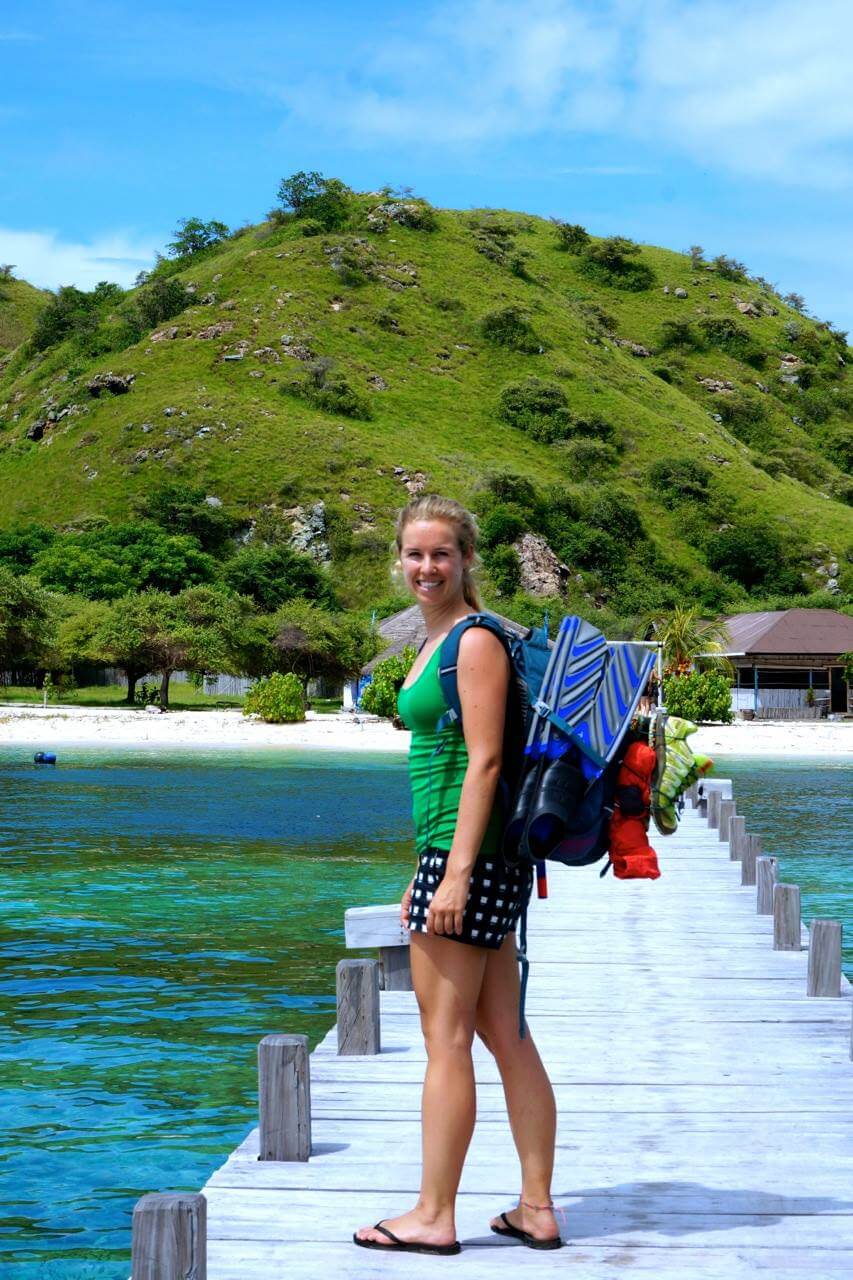
From Komodo we take the long way back to Labuan Bajo, via Kanawa Island just outside the park.
We pass birds enjoying the park on driftwood transport. The blue-green contrasts get stronger as the sun drops. Some of the group are continuing the island lifestyle on Kanawa, so we drop them there, watch the sun go down, and motor on for the last leg.
Kanawa is outside the park boundary, so the no-overnight rule doesn't apply there. The Kanawa Beach Resort is the main place to stay on the island. Simple bungalows, reef out the front door, no traffic and no rush.
If you just want to come for the day, the Kanawa Island day tours on GetYourGuide mostly leave from Labuan Bajo, with snorkel time and a few hours on the beach before the return run.
On the final stretch I see a falling star. I cannot come up with anything to wish for.
What's possible in Komodo today, and how to plan it
If you're going now, here's the shape of it.
Where you can sleep
Three real options:
- On a liveaboard inside the park. Sleep on a Phinisi (the traditional Indonesian wooden boat) anchored in the park's waters. This is the closest thing to what I did in 2014. Standard trip is 3 days, 2 nights from Labuan Bajo.
- In Labuan Bajo, with day trips out. Plenty of guesthouses, hostels, and small hotels in town. Day trips by speedboat or slow boat from the harbour each morning.
- On an island just outside the park. Kanawa, Seraya, Bidadari, Sebayur and Le Pirate all sit outside the protected boundary and all have small eco-resorts. Quieter, slower, less developed than Labuan Bajo, and you fall asleep to the sea.
Option 1: Liveaboard from Labuan Bajo
Departures are usually 9.30 to 10am day 1, return day 3 mid-afternoon. Most include all meals, snacks, water, snorkel gear, briefings, an experienced guide, and towels. You add diving (extra fees, plus the park's per-day diving levy) if you want it.
Itineraries vary. The good ones cover Padar sunrise, Komodo or Rinca dragon trek, Batu Bolong dive, Manta Point, Pink Beach, Kanawa, and Kalong Island bats at sunset.
Look for an operator that:
- Knows the park well (years operating, ideally local crew)
- Caps group size (under 12 is nice; under 20 is workable)
- Pre-books your park permits
- Stops the engine when at anchor
- Doesn't push fishing or anything that conflicts with marine-sanctuary rules
The best place to compare and book is Liveaboard.com's Komodo page. They aggregate most of the operators that run the park, with real reviews, dates, cabin layouts and exactly what's included on each boat. Filter by group size, dive-heavy vs snorkel-and-sightseeing, and budget tier before you book.
Option 2: Labuan Bajo as your base
If you don't want to sleep on a boat, base yourself in Labuan Bajo. The town has grown a lot since I was there. Plenty of accommodation now, hostels to higher-end. Day trips by speedboat hit two to four islands in a day. Less rest, less water time, but you sleep in a real bed.
Here's the map of Labuan Bajo with what's currently available. Pan around, filter by your dates, click through for prices:
Filter for guesthouses or smaller hotels rather than the new resort builds. More local, more interesting, more of your money staying in town. If the map isn't loading, browse the same options on Booking.com directly.
For the day trips themselves, browse the Labuan Bajo tours page on GetYourGuide. Look for slow boats over fast party boats. The slow ones are quieter and the wildlife behaves differently when nobody's blasting music off the side.
Option 3: An island just outside the park
This is the closest you'll get to the feeling we had on Mawan in 2014. Sleep on a tiny island, reef out the front door, no town and no traffic, and do day trips into the park from there. Kanawa, Seraya, Bidadari, Sebayur, Le Pirate. Most are reached by a 30 to 90 minute boat transfer from Labuan Bajo.
For Kanawa specifically, the Kanawa Beach Resort is the one. For the others, search the resort name on Booking.com or in the Stay22 map above (zoom out from Labuan Bajo).
How visits work now
Two things changed when the new rules came in:
- No more overnighting on islands inside the park. Day visits only. You sleep on a boat or off-park.
- Daily visitor cap of 1,000 people, split across three time sessions: 5-8am, 8-11am, 3-6pm. No new entries 11am, 3pm. Around 330 per session.
Entry is permit-based and most tour operators handle the permit for you as part of the package. If you're going independently, you'll need to set it up yourself before flights for peak season. Peak months (June to August, Christmas, New Year) sell out weeks ahead.
What it costs (per person, per day)
- Foreign visitor entry: 250,000 IDR (~€15 / $17)
- Indonesian visitor entry: 75,000 IDR
- Harbour fee: 25,000 IDR
- Diving activity fee: 25,000 IDR
- Ranger fee for Komodo and Rinca treks: 120,000-150,000 IDR per group (mandatory)
Rough liveaboard pricing for 3 days, 2 nights from Labuan Bajo, per person:
- Budget tier: €250-400 (open trip, shared cabin, basic Phinisi)
- Mid tier: €500-800 (smaller group, better cabins, snorkel included)
- Higher tier: €1,000+ (premium boats, private cabins, full dive packages)
Day-trip route: 1-2 nights in Labuan Bajo at €30-80/night, plus a day trip at €60-120 per person. Outside-park-island resorts run anywhere from €40 budget bungalow to €200+ for the more polished places.
When to go
April to June. Dry season, clear water, calm crossings. April, May and September are shoulder months with fewer people and easier permit slots. Avoid January and February (monsoon, rough crossings, cancelled boats). July, August and Christmas/New Year are peak. Beautiful, but book months ahead.
What to pack
- Reef-safe sunscreen (not the chemical kind that bleaches coral)
- Rash guard or long-sleeve UV top
- A waterproof dry bag for the boat and snorkel gear. Nothing on a Komodo boat stays dry without one
- Snorkel and mask if you're particular about fit
- Reusable water bottle (the boats usually have refill stations)
- Cash, more than you think. Labuan Bajo has ATMs, the islands don't
- Light layers for evenings on the boat
- Sea-sickness tablets if you're prone. Currents are real
Travel insurance and connectivity
Indonesia is one of those places where insurance actually matters. Boat trips, diving, dragons that can outrun you. I use SafetyWing for nomad-style trips because it's monthly, multi-region, and covers diving and adventure activity.
For data, pick up an Airalo eSIM before you fly into Indonesia. Reception around Komodo is patchy but Labuan Bajo has 4G.
Getting there
Flights from Bali (Denpasar) to Labuan Bajo are short and frequent. Lombok works too but less directly. From Labuan Bajo airport, town is a quick taxi ride. From town, your boat or transfer is a few minutes from the dock.
A note on operator types
Some of what's sold around Labuan Bajo is loud and not great for the place. Big-group party catamarans, speedboats tearing through manta cleaning stations, jet ski circuits. They're cheaper. They're also part of why the park needed the new rules.
Go slow if you can. Smaller boat, smaller group, longer time in the water. The park rewards patience.
More of Flores beyond the park
Komodo gets all the attention, but Flores is bigger than the park. If you have the time:
- Hiking and mountainbiking in Flores. What to do once you're out of the boat and back on the island.
- Travel tips for Riung. Quieter snorkelling, sunrise hills, less polished.
- The Ti'i ka ebu nusi ceremony at Belaraghi. What a real cultural visit looks like, not the tour-version.
- Learn freediving. If the manta encounters change your life and you want to go deeper, literally.
And if catching a boat ride is calling you, catching a sailboat ride in South East Asia is how I got around the region without flying.
The ocean side of what I do now lives at Ocean Nomads. Community, sailing, ocean conservation done as a practice rather than a campaign.
FAQ
Can you still camp inside Komodo National Park?
Not on the islands inside the park. Overnight stays on the protected islands are no longer allowed. You can still sleep on a liveaboard anchored in park waters, or on islands just outside the boundary like Kanawa, Seraya, Bidadari, Sebayur and Le Pirate, where small eco-resorts have been operating for years.
Can you stay on Kanawa Island?
Yes. Kanawa is outside the park boundary, so the no-overnight rule doesn't apply. Kanawa Beach Resort is the main option there, with simple bungalows on the beach.
How much does a Komodo National Park trip cost in 2026?
Park entry is 250,000 IDR per day for foreigners, plus harbour fees (25,000), diving levies (25,000), and ranger fees (120,000-150,000 per group). A 3-day liveaboard from Labuan Bajo runs €250 budget to €1,000+ premium. Day-trip-from-Labuan-Bajo packages run €60-120 per person.
When is the best time to visit Komodo National Park?
April to June. Dry, calm, clearest water. April, May and September have lower visitor numbers. Avoid January and February (monsoon).
Is Komodo National Park safe with the dragons?
Yes, with a ranger. They're mandatory on Rinca and Komodo Island and good at what they do. Don't wander off, don't visit with an open wound, and women on their period are generally advised to skip the dragon treks (the dragons can smell blood from kilometres away).
Can you visit Komodo from Bali?
Yes, on a flight from Denpasar to Labuan Bajo (1-2 hours). From there, day trips and liveaboards depart. A 3-day boat trip plus a flight day either side is the realistic minimum from Bali.
Final notes
If you're going: do the slow version. Smaller boat, longer water time, fewer islands per day. The park rewards patience and shows much less of itself to people running through it.
If you can't go: the underwater world there is one of the wildest, most alive places I've been in twelve years of doing this work. Worth saving up for.
Stay wild.
With love, Suzanne
Wild at heart? Let's be friends.
Join me on YouTube for slow travel adventures by van, sail and on foot.
Or get my new stories by email, every couple of weeks.
Ocean Nomads is the community I founded, for people who want to live a little wilder, explore a little further, and do it with good people.
For deeper trail stories and the behind-the-scenes, I write on Patreon.
Explore more
Read next

Some links on this page are affiliate links. If you buy through them, I may earn a small commission at no extra cost to you. I only recommend things I actually use and trust. Thank you for the support.





Wat een prachtige ervaring! Ik moet weer flink bij lezen op je blog, loop achterrr!
Indonesië blijft een fantastisch land. Heimwee (zegt ze vanuit de Filipijnen…)
Laura! ZO divers Indonesië! Ik kan daar jaren rondreizen en nog iedere dag nieuwe dingen ontdekken!
Wat gaaf dat je in de Filipijnen bent! Ik houd je blog in de gaten voor de verhalen:) Veel plezier!
Dag Suzanne,
Wat een mooie reisblog! Mijn vriend en ik gaan deze zomer ook naar Indonesië en maken daarbij een uitstapje naar Flores. We hebben maar 3 of 4 dagen en willen ons daarom beperken tot de Komodo Tour (en komen zeker terug voor de rest van Flores). We vonden heel veel goede recensies over Flores XP Tours. Heb jij de 2-daagse Dragon Tour gedaan dus? Op de site van Flores XP staat dat die niet langs Batu Bolong gaat.. De 3-daagse Dragon Tour doet dit wel maar een 2-daagse tour komt ons veel beter uit omdat we hierna nog maar 6 dagen hebben in Java (exclusief vluchtdagen) voor onze terugreis naar Nederland. Daarbij moet ik zeggen dat mijn vriend en ik niet gaan duiken (alleen snorkelen).
Raad je het dus aan om vooraf met Flores XP te boeken? Wij zijn namelijk nog aan het twijfelen. Men heeft mij verteld dat het beter is daar te boeken omdat je dan nog kunt onderhandelen over de prijs (met andere toeristen ook) en je kunt afstemmen op het weer. Maar daarentegen is het ook hoogseizoen als we in Flores zijn dus ik wil het ook op safe spelen.
Alvast bedankt.
Groetjes,
Ivanka
Dag Suzanne,
Wat een mooie reisblog! Mijn vriend en ik gaan deze zomer ook naar Indonesië en maken daarbij een uitstapje naar Flores. We hebben maar 3 of 4 dagen en willen ons daarom beperken tot de de Dragon Tour (en komen zeker terug voor de rest van Flores). We vonden heel veel goede recensies over Flores XP Tours. Heb jij de 2-daagse Dragon Tour gedaan? Wij komen 10 juli aan in Labuan Bajo en willen graag 13 juli doorvliegen naar Malang. 2-daagse Dragon Tour 11-12 juli zou dus perfect zijn maar helaas is deze volgeboekt. Wel kunnen we nog de 3-daagse Dragon Tour doen 11-12-13 juli. Dan moeten we onze vakantie in Java met een dag korter maken. Raad jij in dat geval de 1-daagse Dragon Tour aan of de 3-daagse Dragon Tour? Als we de 3-daagse Dragon Tour doen, betekent het dat we waarschijnlijk alleen Bromo of alleen Ijen kunnen bezoeken In Java. Daarnaast heb ik ook gezien dat FloresXP ook Budget Liveaboard Tours doet van zowel 2 als 3 dagen.
Wij gaan trouwens alleen snorkelen (niet duiken).
Alvast bedankt.
Groetjes,
Ivanka
Hey Ivanka!
Bedankt:) Leuk van je te horen. Ik raad een zo lang mogelijke tour aan! Het is zo ongelooflijk mooi daar, zowel op de eilanden en onderwater. Flores en Komodo national park staan echt in mijn top 5! De Dragon tour is top. Goed verzorgd, fantastische local crew, avontuurlijk en relaxed. Een 1 daagse tour zou zonde zijn. Je bent dan misschien meer aan het varen dan aan het exploren. Java ben ik zelf helaas nog niet geweest. Het trekt me ook steeds minder, met name Bromo, omdat het hartstikke toeristisch begint te worden en op een minder verantwoorde manier. Ik raad aan zoveel mogelijke dagen voor Flores te nemen. Het is een ongelooflijk prachtig en authentiek eiland. Heel veel plezier! Doe Massi en Mikel de groeten van me! Suzanne
Hello
I am hoping to go camping without a tour group – with my own gear somewhere in Komodo National Park. Do you know if this is possible? I tried to contact Flores XP guys but they said we could only go with them or not at all.
Thanks
Hey Kiley,
Komodo National Park is a protected park. You can’t explore this park on your own. You also better not want that with the dragons and dangerous currents. You need local advice. It’s really fun to go camping with Flores XP! If you really want to go by yourself, explore elsewhere around Flores. There’s dozens of islands, as well as inland beauty that are inviting to pitch a tent. Have fun!
HI Kiley…Did you make it camping and if so…Any advice…I’m heading there in March. Also prefer to be independent. Tami
Hey Tami!
Yes I went camping! With FLoresXP. Not by myself. I’m not sure about the regulations… Perhaps check that with Flores Tourism?
Enjoy! It’s absolutely spectacular there! And it’s loads of fun with FloresXP so consider! :)
Hey…I have about ten days following the teaching of yoga retreat in Bali. March 26 tO APRL 6 I’d like to camp on Flores. Do you have advice as the best place to camp. I’m an independent traveler. Is there any place to rent a kayak or paddle board? I’d really appreciate your thoughts.